MEWP Safety: 8 Essential Tips for Facility Managers and Operators
Adapted with permission from AerialPros
Mobile elevating work platforms (MEWPs) make overhead work faster and safer when used correctly.
However, most accidents with these machines can be traced back to preventable issues: gaps in training, poor inspections, unclear site rules, or unsafely exiting platforms.
“Every organization that uses MEWPs needs to have a MEWP safety program in place and be actively following it,” says Matt Hicks, executive vice president of rental for Burwell Material Handling. “That’s the best way to achieve the goal of predictable, incident-free work at height.”
You can use these eight tips to reduce risks and keep projects moving when working with MEWPs.
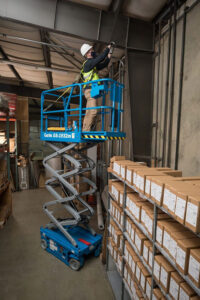
First, what is a MEWP?
A MEWP is a piece of powered access equipment — such as a boom lift or scissor lift — that’s used to position people and tools at height.
Safety will always be a top consideration when it comes to operating these types of equipment. Safe operation starts with proper training, pre‑use inspections, site assessments, and adherence to manufacturer guidance.
“Most serious events start as small deviations, like skipping a pre‑use check or reaching past a guardrail,” Hicks says. “The prevention is generally simple: Follow your safety protocols and plan every time.”
The Top 8 MEWP Safety Tips
The best way to reduce risks while operating a boom lift and scissor lift is to know and follow these eight tips:
- Get trained on the exact machine: Complete qualified, hands‑on training on the specific model you’ll use. Read the operator’s manual and safety decals, and learn the controls and safety devices before operation.
- Inspect the machine and the work zone before each shift: Perform pre‑operation inspections and function tests. Tag out any unit that fails and remove it from service. Assess the work area for drop‑offs, holes, slopes, slippery/unstable surfaces, overhead obstacles, and power sources.
- Communicate hazards and plan rescues: Don’t assume others know the risks. Use radios or phones in the platform and have a documented rescue plan if secondary lowering fails.
- Wear the right PPE and tie-off to anchor points: Use a properly fitted full‑body harness and an appropriate lanyard/SRL when required and connect to approved anchor points. Select vests, boots, and hardhats per site conditions.
- Keep platforms clear of debris: Remove scrap, buckets, and large toolboxes that could create trip hazards. A clean platform improves mobility and focus.
- Only elevate on firm, level surfaces: If a tilt alarm sounds, lower and reposition to level ground before elevating. Never ignore stability warnings.
- Don’t sit, stand, or climb on guardrails: Maintain firm footing on the platform floor. If you can’t reach, reassess whether the MEWP or an approved accessory is appropriate for the task.
- Don’t exit an elevated platform without training: Always maintain 100% tie-off and get an approval letter from the manufacturer that provides the proper guidance. Do not climb down from the platform when it’s raised.
Rollout Checklist:
- Audit: List all MEWP models on site; verify manuals and decals are present and readable.
- Train: Schedule operator refreshers and supervisor briefings on site rules and rescue plans.
- Inspect: Implement a documented pre‑use and function‑test process with tag‑out/repair flow.
- Mark: Improve signage/markings near drop‑offs, overhead hazards, and power sources.
- Equip: Confirm harnesses, lanyards/SRLs, radios/phones, and rescue equipment are available.
FAQ: MEWP Safety Tips
What should a pre‑use inspection include?
Check structure, tires, hydraulics, controls, alarms, emergency lower, decals/manuals, and battery/fuel. Make sure to perform function tests before elevating.
Can I exit a MEWP at height?
Only with proper training, authorization, and manufacturer guidance — while maintaining 100% tie‑off. When in doubt, do not exit.
What’s the fastest way to improve MEWP safety?
Start with consistent training, documented pre‑use checks, and clear rules about guardrails, tilt alarms, and platform housekeeping.
Next Step
Need help tightening up your MEWP safety program? We can review your models, training, and site rules, and recommend areas to improve.