

How to Troubleshoot Commercial Doors: What’s Really Causing The Problem?
When a commercial door starts sticking, slamming, or refusing to close, it’s tempting to assume it’s just a hinge or a sensor. But the real issue often runs deeper—and catching it early can save you time, money, and unnecessary downtime.
“Nothing gets people more frustrated than a door that won’t behave,” says Tom Racer, project engineer for Engineered Solutions at Burwell Material Handling.
Why Troubleshooting Commercial Doors Matters
A malfunctioning commercial door doesn’t just slow your team down. It can compromise security, create safety risks, and rack up repair costs. Smart troubleshooting helps you:
- Identify root causes before they escalate
- Reduce unplanned downtime
- Protect employee safety
- Save money on repeated part replacements
“There’s been times where the same part was swapped out over and over,” Racer says. “The real problem wasn’t the part. It was the frame, the wiring, or even how the building itself was shifting.”
Here are some of the most common issues, and what they might really be telling you.
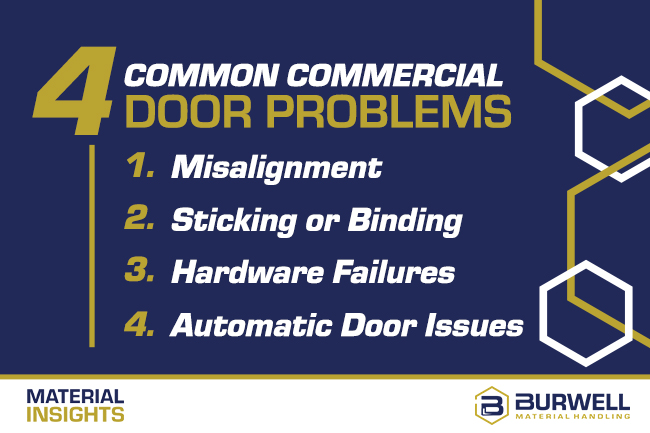
Common Commercial Door Problems and Fixes
- Misalignment: More Than Just Loose Hinges
What it looks like: The door drags, doesn’t latch, or looks crooked in the frame.
Possible cause: Building settling or temperature swings may have shifted the frame itself.
What to check:
- Use a level to check the frame’s alignment.
- Look for signs of warping, especially in older buildings.
- Tightening hinges might help, but it won’t fix structural movement.
“Think of a door like a zipper,” Racer says. “If the track gets twisted, it doesn’t matter how many times you tug on it. It’s never going to close smoothly until you straighten things out.”
- Sticking or Binding: Not Just a Lubrication Issue
What it looks like: The door sticks when opening or closing.
Possible cause: Dirt buildup, swollen materials, or worn rollers could be the culprit.
What to check:
- Clean tracks and rollers thoroughly.
- Inspect for flat spots or debris.
- Check weather stripping — if it’s deteriorated, it could be causing friction.
“When a door feels like it’s fighting you, it’s usually telling you something,” Racer says. “It might be dirt, it might be wear, but whatever it is, forcing it only makes things worse.”
- Hardware Failures: A Sign of Bigger Wear
What it looks like: The door slams, won’t latch, or hardware feels loose.
Possible cause: High-traffic use or poor-quality components may be wearing out faster than expected.
What to check:
- Test operators for smooth, consistent motion.
- Listen for grinding or clicking sounds.
- Check cables for frays or kinks.
“I always say hardware is like your check engine light: It’s usually the first thing to act up when the system as a whole is wearing down,” Racer says.
- Automatic Door Issues: Sensors Aren’t Always to Blame
What it looks like: The door opens erratically or not at all.
Possible cause: Power fluctuations, wiring issues, or motor fatigue could be the root cause.
What to check:
- Use a multimeter to test voltage at the motor and sensors.
- Inspect wiring for damage or loose connections.
- Check the control panel for error codes.
“People want to blame the sensor because it’s the part they can see,” Racer says. “But may times, the problem’s hiding in the wiring or the motor.”
Safety First: Always Take Precautions
Before you start any formal investigating or diagnostics, make sure you:
- Disconnect power before working on automatic doors
- Use PPE like gloves and safety glasses
- Use stable ladders or platforms when working at height
When to Call a Professional for Commercial Door Repair
Some issues are best left to trained technicians, especially when safety, compliance, or warranty coverage is on the line. Call a professional if:
- The door’s structural integrity is compromised
- You’re dealing with complex electrical or access control systems
- The door is part of a fire-rated or life safety system
- The door is still under warranty
FAQ: Troubleshooting Commercial Doors
What causes commercial doors to stick?
Sticking is often caused by dirt in the tracks, swollen materials, or worn rollers — not just a lack of lubrication.
Why won’t my automatic door open consistently?
Erratic automatic doors are usually linked to wiring issues, power fluctuations, or motor fatigue — not always faulty sensors.
When should I call a professional for commercial door repair?
Call in experts if the door’s structure is compromised, it’s tied to fire or life safety systems, or the issue involves electrical components.
How do I know if my door is misaligned?
A misaligned door may drag, fail to latch, or look crooked in its frame. Checking with a level can confirm if the frame has shifted.