
Before You Automate: What to Address Before You Invest
Automating your material handling process can absolutely bring many benefits, but only if you do it at the right time for your organization.
If you try to automate a broken process or fix one bottleneck yet create a bigger one downstream, you’re putting your investment at risk. In addition, you could be creating other workflow problems for your products and teams.
Stephen Leu, business development manager for Burwell Material Handling’s Engineered Solutions team, says every automation project should begin with clarity on the current state and what your goals are. The focus first needs to be on the problems you want automation to solve before you start evaluating products and vendors.

“The first thing that we would do with a customer is gauge where their operation is today,” Leu says. “And where do they see themselves in the next two, three, five years?
Here’s what your organization needs to address before you automate your warehouse.
1) Identify what areas could improve with automation
Leu says automation should be driven by real pressures. He encourages operations to examine their growth and constraints, because that determines which solutions even belong on the table.
“Usually growth is in two areas: storage or throughput,” Leu says. “We had one customer where they were experiencing 30% growth year-over-year on the throughput side. They could not keep up with manual labor at that rate.”
But growth isn’t the only reason to consider automation. Sometimes the driver is risk.
“Sometimes it’s order accuracy,” Leu says. “Sometimes it’s liability, and risk mitigation is their entire reason to automate.”
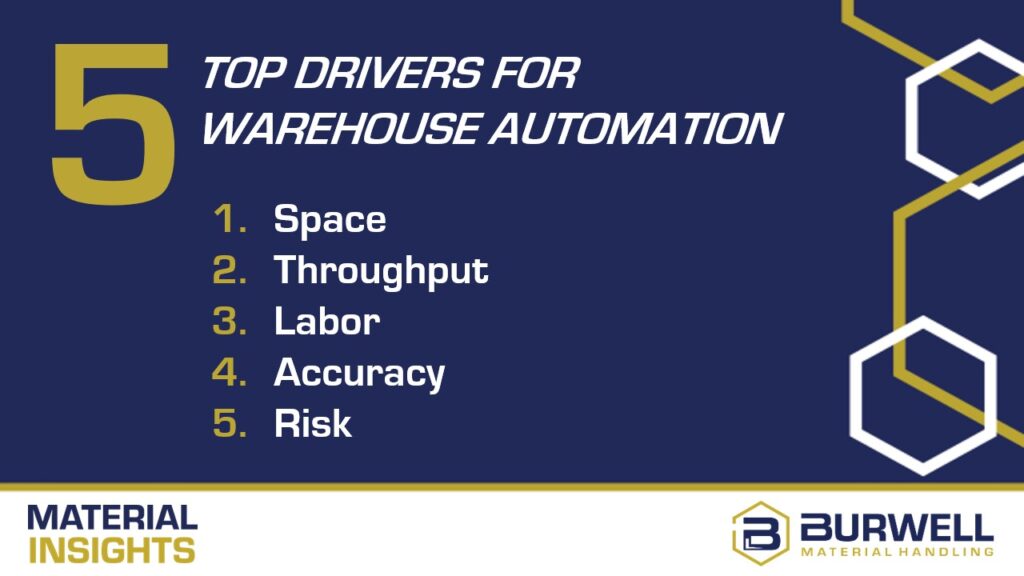
Practical takeaway: If you can’t clearly name your driver (space, throughput, labor, accuracy, risk), you could unwittingly get distracted by “cool tech” instead of outcomes.
2) Fix the warehouse essentials that create chaos
If receiving, storage, pick paths, or dock flow are strained, automation isn’t always the immediate answer to solve your underlying disorder. In fact, it can often make your constraints more chaotic and costly if not addressed properly first.

Before you launch into any automation project, Leu recommends partnering with an expert to evaluate your warehouse essentials before proving automation in a zone. For example, are your docks and doors operating as they should? Do you need more racking or shelving? What about your material flow or picking process? Do workflows need to be adjusted?
“Talk about your pain points first,” Leu says. “Don’t get ahead of yourself and start talking about what’s in the market. Find out where you can get the biggest bang for your buck and start there.”
3) Pressure-test your warehouse bottlenecks
Without a doubt, automation is designed to reduce or eliminate bottlenecks. Before you invest, work with your automation partner to model what happens when the first constraint improves.
“For example, if your pack stations are the current bottleneck, when we help your packing stations, the next bottleneck will also be picking,” Leu says. “Right now you can’t see that, but it will become a bottleneck next.”
Map out your entire workflow and develop a plan to address new bottlenecks in stages.
“You want to make sure these issues are on your radar at the outset of your initial project or address them simultaneously, if you can,” Leu says.
4) Get serious about data
Most teams say they want automation. In order to succeed though, you need baseline data to size the problem and build a business case.
“Sometimes a customer says, ‘we need to automate,’ but it takes them a month and a half to get us the data,” Leu says. “They have to feel enough pain to qualify the problem to move forward.”
At minimum, be ready with order volume patterns, SKU velocity, throughput ceilings, space constraints, error drivers, labor constraints, and peak season realities.
5) Don’t confuse implementation with transition
The installation of any new product or technology is one issue. Keeping the warehouse shipping while change happens can be a bigger one, especially in brownfield facilities.
“A brownfield means it’s an existing building,” Leu says. “Customers can’t shut off their operation for the 12 months that the installation is happening.”
He says the transition plan is actually a bigger deal than the implementation plan. This needs to be carefully mapped out between your organization and your vendor partner.
“The implementation plan is just how we execute,” Leu says.
6) Avoid show-and-tell until the problem and budget are real
The primary purpose of an automation product or technology demo should be to validate a business case, not create one.
Leu warns it’s easy to get stuck in “cool tech tourism” and lose momentum if the pain isn’t real enough to change.
“This stuff is so cool, you can easily get stuck in the phase of six different site visits,” he says. “But that ‘cool factor’ alone will fizzle out, and it’s not enough to change anything.”
Let the cold, hard facts of your problems backed by data do the talking to drive your decision-making process. Then review solutions that fit your budget and plans before you go see them in the field.
Next step: A ready-to-automate gut check
Before you move forward with automation for your warehouse operations, ask yourself these questions:
- What pressure are we solving (space, throughput, labor, accuracy, risk)?
- What is our baseline (today’s throughput, errors, travel, congestion)?
- Which constraint is costing the most right now?
- What happens if we alleviate that constraint (where does the bottleneck move)?
- What data can we provide quickly to size the problem?
- How do we keep shipping during change (transition plan)?
Ready to find solutions for your pains? Connect with your Burwell Material Handling team of experts today.