

What Is Parts Consignment for Forklift Fleets?
A forklift can be out of service for a surprisingly small reason: a light, a horn, a seat switch, a filter.
These parts aren’t hard to replace, but still require time to order, ship, receive, and install — all of which quickly adds up in costs and production.
Parts consignment is one way operations teams reduce that waiting game by keeping the right “most-used” parts on-site, so repairs and PM work don’t stall.

Lindsey Coffman, district service manager for Burwell Material Handling, says a parts consignment program helps fleets put the right parts where material handling work is happening. Fleet managers work with their vendors to select and stock the parts they either most frequently need or are the most impactful to uptime and their operation.
“Normally, the dealer puts a locker or cabinet of some sort on site that would store whatever parts in particular we’re choosing to have at that location,” Coffman says.
So what exactly is parts consignment for forklift fleets — and when is it worth doing?
Parts consignment essentials
Parts consignment is an on-site parts inventory built around your fleet and how you run. Consignment models vary, with some where the dealer retains ownership of inventory until parts are used and others where the fleet pays for a portion of the inventory upfront.
Coffman says your operation needs at least two essential factors before considering whether a parts consignment program is right for you:
- An on-site service technician: This could be a staff technician or a resident technician through your vendor, available for maintenance and repairs at your location.
- Space to store the parts: This is typically a locker or dedicated storage area.
If you have at least those two things, Coffman says each program then proceeds with a site evaluation and a collaborative plan:
“Most often, the dealer sends someone out, ideally a parts sales rep and service manager, to see the area and evaluate the site,” Coffman says. “Then when it comes to determining how to stock it, it’s based on their fleet and usage.”
Coffman says parts consignment inventory is then tailored to your operations’ most commonly used parts. It’s then managed in partnership with your vendor as a program with:
- Defined min/max stocking levels
- Reorder points based on usage and lead time
- Tracking and reconciliation routines
- A regular review rhythm to keep the stock relevant
Who parts consignment is usually right for
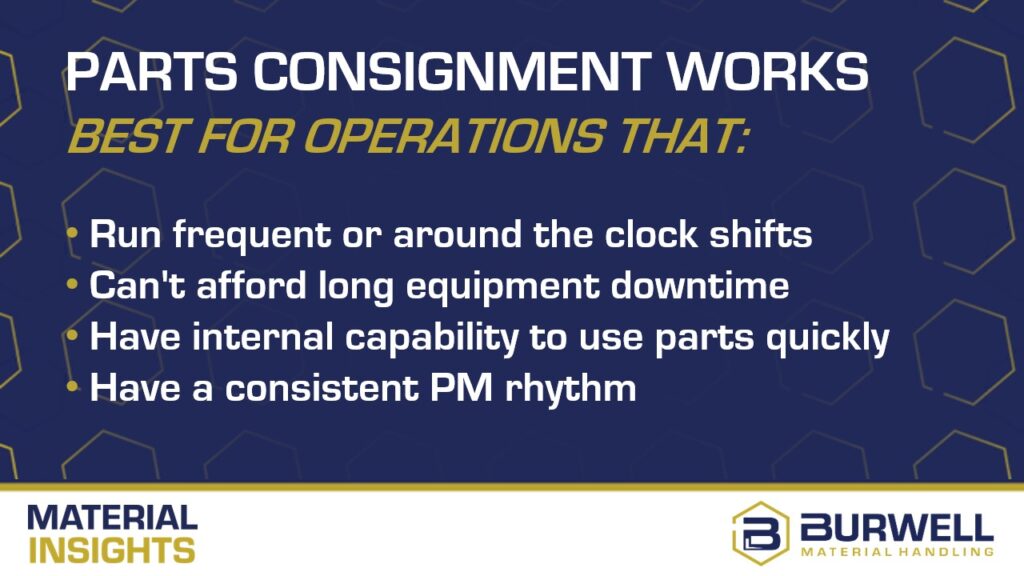
Parts consignment is usually best for operations that:
- Run frequent or around the clock shifts
- Can’t afford long equipment downtime
- Have enough internal capability to use parts quickly
- Have a consistent PM rhythm
Coffman says typically the right operations to consider parts consignment have 20 or more forklift trucks in their fleet.
What kinds of parts typically belong in a consignment locker?
In general, the parts list should reflect two things:
- High-use parts that you repeatedly consume
- High-impact parts that can stop operations or trigger tag-out policies
“It’s usually your basic PM parts and things that get changed quite often,” Coffman says. “Parts like safety items, horns, lights.”
She says an ABC criticality analysis will keep your consignment inventory focused:
- A parts: High downtime impact → stock onsite always
- B parts: Moderate criticality → limited quantities
- C parts: Low risk → dealer warehouse only
Why parts consignment can change downtime math
When parts are on-site, maintenance doesn’t have to pause while someone places an order and waits for delivery. Coffman says this offers fleet managers distinct benefits, including:
1) Reduced downtime and faster repair response
Downtime is where the “true cost” lives: Missed shipping windows, idle labor, overtime recovery, and production disruption.
“With a consignment program, you’re increasing their uptime because you have the parts available on site,” Coffman says. “You can go right in and grab them, and it allows them to just move on with their day versus a truck being down, waiting on a part to be ordered.”
There’s also the fact that “fast” shipping from a vendor for an in-stock part you need isn’t always fast enough.
“Depending on when your machine goes down, it could take 48 hours sometimes, even when you order it next-day air,” Coffman says.
2) Better planned maintenance execution
Consignment doesn’t just help when things break — it helps you complete planned work.
When parts are on-site, technicians are more likely to perform proactive repairs during PM windows instead of deferring them and hoping nothing fails before the next visit.
3) Reduced expedited freight and emergency logistics
Similar to reducing the wait for an emergency parts order, consignment also reduces costs associated with premium freight and rush sourcing, such as overnight shipments, weekend deliveries, couriers, and other “get it here now” costs.
Parts consignment isn’t about eliminating every emergency order, because there will always be surprises you can’t plan for. It’s about removing the predictable delays tied to common wear and safety items.
The overlooked benefit: parts data shows you what’s really happening
Consignment also creates visibility into patterns, especially when you track usage consistently.
“It’s really crazy what you can identify simply through your parts usage,” Coffman says.
For example, repeated forks replacements due to bending in a short time frame could indicate the operator is overloading the machine and may need retraining or to select a different truck with a higher capacity.
That usage monitoring can turn parts consignment into a tool for training, safety, and damage reduction, Coffman says.
What a well-run consignment program looks like
After the initial set-up, Coffman says you need to track usage closely. This can be a manual process or automation can assist your operation, but it must include:
- Logging issued/used parts (date, tech, asset reference)
- Weekly cycle counts and monthly full counts (so inventory and invoicing stay accurate)
Your vendor should also work closely with you to monitor usage, she says.
“The first three months should be a monthly conversation to get an idea of your usage pattern,” Coffman says. “Then you would move to quarterly meetings.”
Reordering should occur based on historical usage and lead time, with parts manager approval on restock orders and typical replenishment in 1-3 business days depending on urgency.
Your operation should also incorporate these KPIs to track the success of your program:
- Stockout rate ≤ 2%
- Inventory accuracy ≥ 98%
- Replenishment lead time ≤ 3 business days
- Customer satisfaction via quarterly feedback
Next step
Learn more about your parts options today by contacting your Burwell Material Handling team.