
Forklift Tire Selection: How to Choose the Right Tire for Your Floors, Duty Cycle, and Uptime
When something goes wrong with your forklift’s tires, such as chunking, delamination, traction issues, or repeated flats, it can put a truck out of service at the worst possible time.
“Tires are one of those parts that feel routine, until they turn into the reason you’re short on capacity,” says Chris McCauley, district director at Burwell Material Handling. “If you’re replacing the same tire the same way every few months, the tire isn’t the real problem.”
It’s important to know the basics of forklift of tire selection, like whether you require a cushion vs. pneumatic, but that’s only the starting point.
Where teams can get burned is when they select tires based on indoors vs. outdoors and ignore the two things that actually kill tires: duty cycle/heat and site conditions/debris.
Here’s an in-depth guide to forklift tire selection, based on your material handling operation’s specific needs.
Start with the three drivers that decide tire life
1) Surface and debris
Smooth concrete is not the same as rough concrete. A clean warehouse is not the same as a facility with metal shavings, broken pallets, or dock plates that chew tread.
“Think about what’s on the floor at 2 p.m., not how it looks when it’s clean and pristine right after housekeeping,” says McCauley. “That’s the environment your tires live in.”
2) Duty cycle and heat
Heat changes how tires fail. And high-speed travel, long runs, heavy loads, and multiple shifts all generate heat.
“Heat is what sneaks up on people,” McCauley says. “A tire that looks right for the floor can still fail early if the trucks run hot all day.”
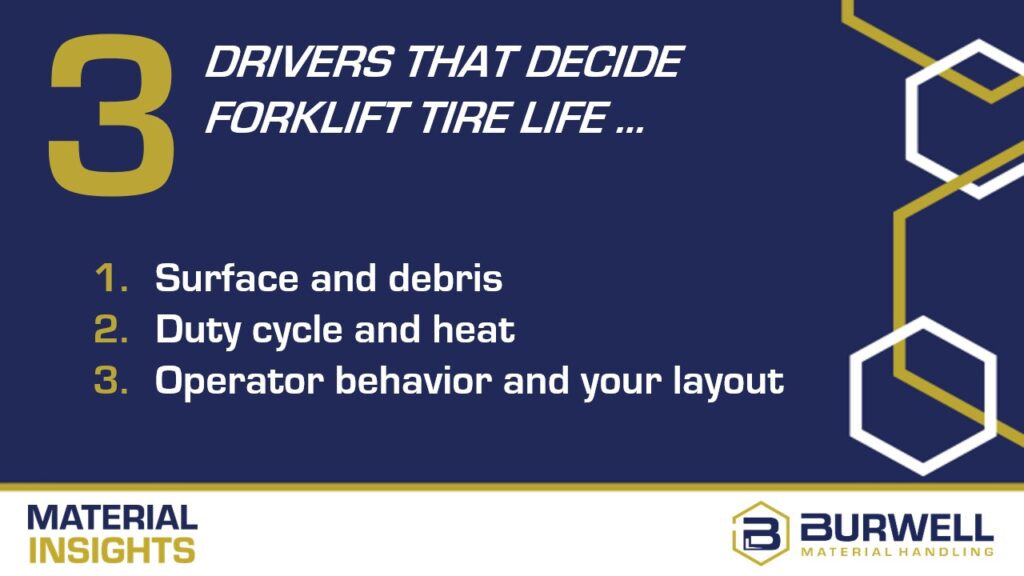
3) Operator behavior and your layout
Sharp turns, high-speed cornering, and repetitive impacts create predictable wear patterns. If your layout forces tight turns under load, tires will show it.
“When the same trucks keep going through tires, I always look at the lanes and the turns,” says McCauley. “Sometimes the fix isn’t a tire; it’s how the work is flowing.”
The quick forklift tire type guide
Cushion (press-on) tires
Cushion tires are solid rubber mounted to a steel band, commonly used indoors on smooth surfaces. They’re typically chosen for warehouses and docks where you need a tighter turning radius.
Best fit: Smooth indoor floors, tight aisles, high maneuverability.
Watch-outs: Traction limitations in wet/contaminated areas; harsh surfaces accelerate wear.
Pneumatic (air-filled) tires
Pneumatic tires provide better shock absorption and are typically used for outdoor or uneven surfaces.
Best fit: Yards, rough asphalt, mixed indoor/outdoor routes.
Watch-outs: Punctures and pressure management.
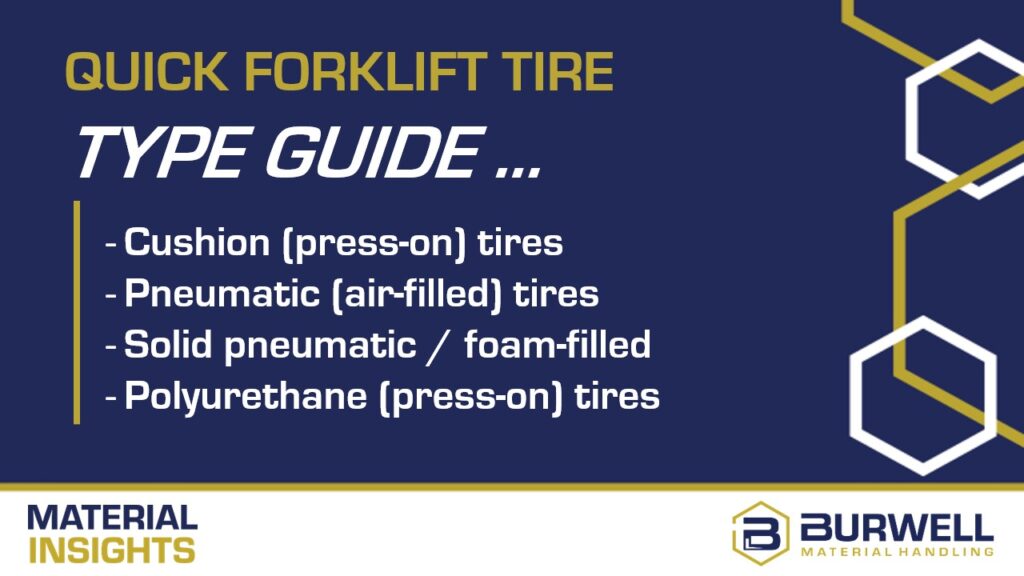
Solid pneumatic / foam-filled
These are common when you need outdoor capability but can’t tolerate frequent flats. They’re not “better” universally – just better for puncture-heavy environments.
Polyurethane (press-on) tires
Polyurethane often shows up as long-wearing in the right indoor applications, but they should not be a default upgrade. Heat behavior matters, especially at higher speeds or duty cycles.
“Poly has its place,” McCauley says. “But if your trucks run hot and fast, you can turn a tire choice into a failure pattern.”
Match tire choice to where you run
Here’s the operator-reality version of selection, because indoors vs outdoors is an over-simplification of the criteria:
- Smooth indoor, tight aisles: Cushion is usually the starting point.
- Indoor with long runs, high speed, heavy loads: Pay extra attention to heat and wear patterns; compound and duty cycle matter.
- Outdoor yard, rough asphalt, debris: Pneumatic/solid pneumatic usually fits better for traction and shock absorption.
- Puncture-heavy environments: Solid pneumatic / foam-filled may reduce downtime from flats (but still needs proper fit and PM).
“I always ask where the truck spends its hardest hour in a shift,” McCauley says. “That hour should decide the tire, not the easy part of the shift.”
The failure pattern guide: what your tires are telling you
Instead of swapping tires and moving on, use the failure to diagnose root cause.
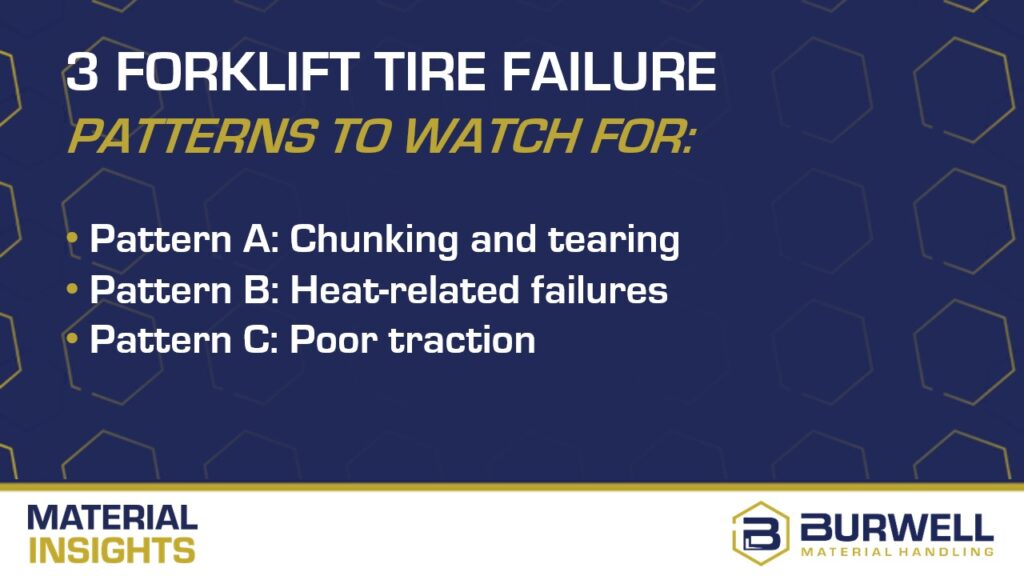
Pattern A: Chunking and tearing
Often tied to debris, sharp turns, aggressive braking, or compound mismatch.
First fix: Walk the highest-wear travel paths; address debris sources; review turn points; consider compound changes.
Pattern B: Heat-related failures (especially in high-speed or multi-shift use)
Heat build-up can drive premature failures, particularly when tire type doesn’t match speed and duty cycle.
First fix: Assess duty cycle (speed + travel distance + load); reduce sustained high-speed runs; consider tire type/compound that fits heat load.
Pattern C: Poor traction, especially on wet or contaminated floors
Cushion tires are often chosen for indoor use, but traction can be a limiting factor in certain conditions.
First fix: Identify where traction loss occurs (dock approach, freezer entry, washdown area); address floor contamination and choose tread/compound that fits.
“The tire is actually a source of feedback into potential problem areas in your facility,” says McCauley. “If you keep seeing the same failure in the same area, your operation is giving you a free root-cause report.”
Build a simple tire program so problems don’t surprise you
Evaluating your forklift tires should be part of your daily and weekly routines.
A practical tire program looks like:
- Daily (operator): Quick visual inspection for cuts, chunking, and embedded debris; pneumatic pressure check when applicable.
- Weekly (maintenance): Document wear patterns by truck/zone; investigate repeat damage locations.
- Monthly (fleet manager): Track replacements by location/shift; identify repeat offenders (same routes, same tasks, same operators).
“If tires are a repeat downtime issue, that points to a gap in your operation,” McCauley says. “Once you track failures by where they happen, it’s easier to figure out what needs to be fixed.”
Next step
If you need help making the right call quickly for your forklift tire selection, contact your Burwell Material Handling team of experts today.