When to Rent vs Buy Material Handling Equipment: 15 Questions Operations Leaders Should Ask
When you need to move more product or materials, whether because peak season is coming, a truck is down, production is ramping up, or a new line is launching, you don’t have time to draw out your search for the equipment you need.
But should you rent vs buy material handling equipment?
In general, rentals can help cover short-term, seasonal, or uncertain needs, while buying or leasing may make more sense when equipment supports a consistent part of your operation or long-term business strategy.
The right answer depends on how often you’ll use the equipment, how critical it is to production, what configuration you need, and how you plan to manage maintenance.
This guide is intended to help you work through that evaluation quickly, so you don’t end up with equipment that doesn’t quite match your needs, a short-term solution that stretches longer than planned, or an owned asset that isn’t fully supported.
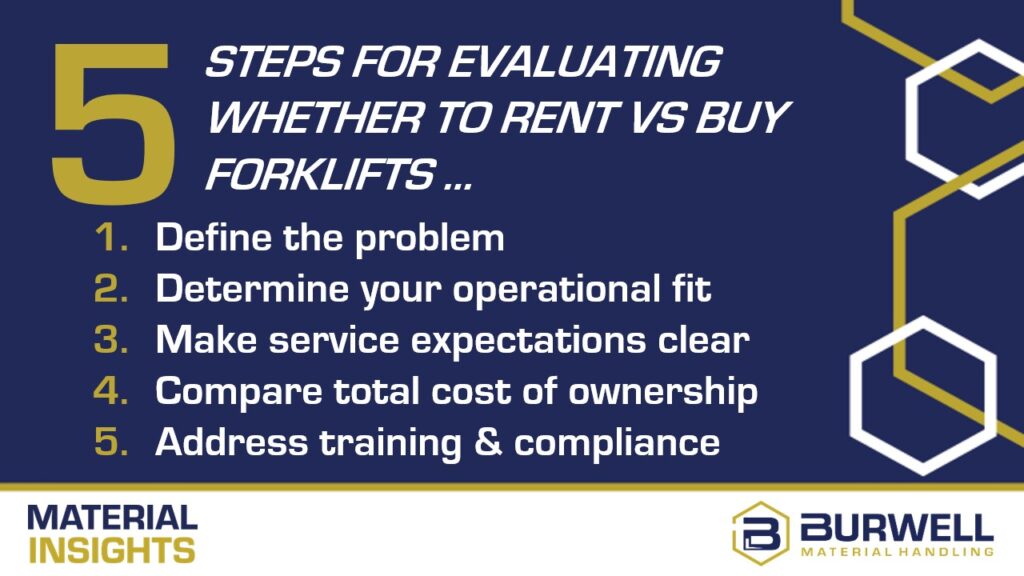
Here are the questions to work through.
First: Define the problem you’re trying to solve
1) Is this capacity need temporary, intermittent, or part of your long-term strategy?
Most rent/buy decisions start with understanding how the equipment supports the business.
Short-term rentals can make sense for peak demand, limited-scope projects, production ramp-up, or when a unit is down.
Purchasing or leasing may make more sense when usage is consistent, the equipment is tied to a long-term business strategy, or the configuration is specific to your operation.
“Start by looking at your business model and how often the equipment will be part of the work,” says David Levingston, district director for Burwell Material Handling. “Think about your upcoming projects and what can best support you from a longevity standpoint. If you have an ongoing or intermittent over the next few years, buying may still make more sense compared to renting.”
Ownership can create long-term value, but it also means accounting for the maintenance strategy.
“Buying can be the right path when the need is consistent, but you have to weigh the maintenance side of that decision,” Levingston says. “Do you have the capability to support maintenance internally, or do you need a service plan that helps protect the total cost of ownership?”
2) What’s driving the decision: Peak volume, a downtime gap, a new workflow, or a facility change?
Your answer changes what you should optimize for: peak volume (availability), downtime coverage (swap expectations), new workflow (pilot fit), facility change (constraints + training).
The equipment decision should match the reason behind the need.
3) If demand drops, can you right-size your fleet accordingly?
Renting is often used to scale up without long-term commitment, especially if demand is too unpredictable to accurately forecast. The key question is what happens when the surge ends.
“A rental’s flexibility can be helpful when the need is short, so you don’t overcommit in capital costs for equipment,” Levingston says.
Second: Determine your operational fit so you don’t get “close enough” equipment
4) What equipment class and configuration is non-negotiable?
Get all your facility and equipment specs outlined, including capacity, required lift height, mast type, overall height restrictions, turning radius, and aisle widths.
Also consider how the equipment will be used across the operation. A truck that works for one task may not work for another if the load weight, travel path, surface, attachment, or lift height changes.
5) What are your real constraints: Inside/outside, ramps, floor condition, dock plates, freezer/cooler, etc?
Think through the full site, not just one constraint. That includes indoor and outdoor use, aisle widths, yard conditions, lift heights, load weights, ramp grades, dock plates, floor conditions, and any areas where one piece of equipment may need to support multiple tasks.
“You have to look at the whole operation: what you’re lifting, where it’s moving, the heights, the weights, the yard, the building, and the space the equipment has to work in,” Levingston says. “The right unit should help you maximize efficiencies for both costs and production.”
If you need help with a site survey, an experienced equipment representative should be able to assist you in evaluating the requirements.
6) What attachments are required, and what happens if they’re unavailable?
Attachments change cycle time and safety. Ask what’s required (side-shift, fork positioner, clamps), whether it’s available, and who maintains it.
If the attachment is critical to the work, it should be part of the rental, lease, or purchase conversation from the beginning.
7) If electric, do you have the battery/charger plan?
Ask whether a charger is included, where it will be located, whether opportunity charging is expected, and whether your facility has a safe charging space and the power capacity to support it.
“With electric equipment, it’s not just whether the truck fits the job,” Levingston says. “You need to know whether your facility is adequately equipped with charging infrastructure.”
Third: Make service expectations clear
8) Who owns planned maintenance during the term?
Ask what “full service” includes and what it doesn’t.
“When you’re setting up a maintenance plan or service agreement, make sure the expectations are clear on the front side,” Levingston says. “Talk through what service includes, what the PM intervals should be, and what support you should expect so there’s a shared understanding from the outset.”
9) When a rental goes down, what’s the swap/replace policy?
Get it in writing: Response time, swap eligibility, and whether comparable equipment is guaranteed or provided on a best-effort basis.
Ask who to call and what the response process is expected to look like.
10) What local parts and service coverage exists for this exact unit?
Mixed fleets can sometimes expose lead-time issues. Ask about local coverage and parts availability.
A unit may look like the right fit on paper, but if support is limited in your market, downtime risk can increase.
Fourth: Compare total cost with the right lens
11) What’s the “all-in” cost?
Ask about delivery/pickup, tire wear and damage terms, after-hours service, attachments, batteries/chargers, damage responsibility, planned maintenance, and any service exclusions.
The lowest monthly payment or rental rate may not be the lowest total cost if the equipment requires extra support or causes downtime.
12) What’s the cost of downtime in your operation?
Use a simple internal estimate: Loaded labor cost per hour impacted, lines/shipments delayed, rental replacement cost, and overtime recovery.
If a truck is tied directly to production, shipping, receiving, or a critical material flow, downtime cost should influence your decision.
13) If you lease, does the term match how long the truck will be efficient for your duty cycle?
Leasing can work well when term and usage are aligned. Misalignment is what creates regret … and extra cost.
If the equipment will see heavy use, think carefully about whether the lease term matches the application. If the term is too long for the duty cycle, you could be dealing with higher maintenance needs before the agreement ends.
A lease can also be useful when you want a planned fleet refresh cycle instead of running equipment until maintenance costs stack up.
14) If you buy, what’s the lifecycle plan (maintenance + replacement)?
Buying your equipment needs to come hand-in-hand with a plan for its service, whether handled internally or externally, and what its costs are to maintain vs when to dispose of the asset.
Fifth: Address compliance and operator realities
15) Who owns training, policy updates, and fleet standards when equipment needs change?
Whether the equipment is rented, leased, or owned, make sure operators are qualified and trained for the equipment they’ll use.
“Any time your equipment needs change, you need to make sure qualified operators are using it correctly,” Levingston says. “That applies whether the unit is owned, leased, or rented. Rental equipment is still part of your safety and training responsibility.”
This is especially important when a rental is brought in quickly to cover a short-term need. The temporary nature of the equipment doesn’t remove the responsibility to use it safely.
A quick decision summary for when you need it most
- Lean rent when the need is temporary, uncertain, seasonal, tied to ramping up production or you need immediate coverage.
- Lean buy when usage is steady, the equipment is integral to your operation’s plans, you have a maintenance strategy in place, and you want the lowest long-run cost.
- Lean lease when you want predictable payments, a planned fleet refresh cycle, and a way to avoid gradual, stacking maintenance costs as equipment ages.
Next step
Need help with your rental, leasing, or buying decision? Contact your Burwell Material Handling team of experts today.