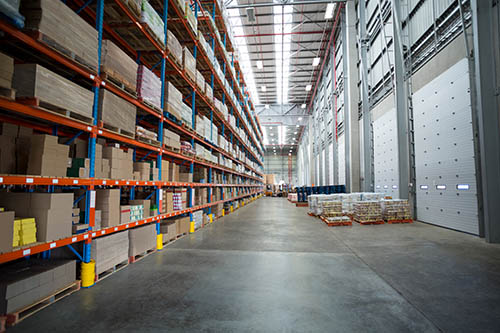
Warehouse Assessment Playbook: How to Diagnose Flow, Space, and Safety Issues
When a warehouse feels strained, the first instinct is often to name the problem too quickly.
- “We need more space.”
- “We need automation.”
- “We need more people.”
- “We need to pick faster.”
Any of those may be true. But before you invest in equipment, technology, layout changes, or a larger facility, you need to know where the real constraint is showing up.
Partnering with a team of experts to perform a warehouse assessment will help identify whether the issue is flow, space, process, labor, safety, or a combination of all of the above.
Stephen Leu, Business Development Manager for Burwell Material Handling’s Engineered Solutions team, says when he enters a warehouse, distribution center, or manufacturing facility, there is always one immediately huge tell.
“One of the first things I’m looking for is going to be forklifts in the same aisle or order pickers in the same aisle that you’ve got pickers on the ground,” Leu says.
That observation reveals more than a safety risk; it also points to potential slotting issues, inefficient picking, or product stored in an underutilized manner.
Here’s how to start diagnosing flow, space, and safety before you decide what to fix.
Start by watching how people, product, and equipment share space
The first signs of a warehouse problem are often visible on the floor.
Are forklifts and pedestrians sharing the same aisle? Are order pickers working around ground-level picking activity? Are employees constantly moving around each other to get to the same product? Are aisles technically open but functionally congested?
Those signs point to both safety and flow concerns.
“I think not only does that create a safety situation, but it also inherently means that you’ve got pickable product on the floor and pick zones in the air,” Leu says.
In other words, when too many people and machines are working in the same space, the problem may not be that your layout is forcing your team into inefficient and unsafe interactions.
That can point to bigger questions:
- Is pickable product stored in the right location?
- Are high-velocity items easy to access?
- Are forklifts doing work that could be separated from pedestrian activity?
- Are people traveling farther than they need to?
- Are storage and pick zones designed around today’s order profile?
A good assessment does not look at safety as a separate category, because safety, flow, and productivity are all connected.
Look for open cases, unit picking, and repeated handling
One of the clearest signs of automation potential is a work-pattern problem.
If you look down an aisle and see open cases, broken-down product, or workers picking individual units, that is worth flagging.
“When I talk to teams that say we don’t even know what to look for, one of my primary things is that I’ll just show them a picture,” Leu says. “If you look down an aisle and you see open cases or you see unit picking, that’s all you need. That’s enough for us to say there’s potential for automation here.”
This is because unit and case picking usually involve a lot of manual labor and potential for overlaps, inefficiencies, and inaccuracies.
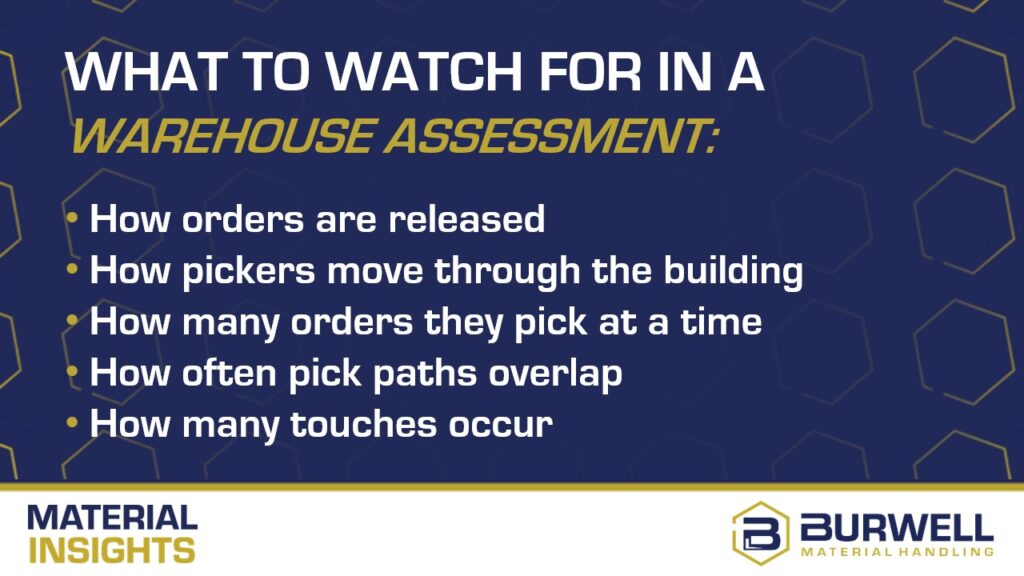
A warehouse assessment should watch:
- How orders are released
- How pickers move through the building
- Whether they pick one order or multiple orders at a time
- How often pick paths overlap
- How many touches happen before product reaches packing or shipping
The goal is to understand whether the work itself has enough repeated motion, travel, touches, and labor to justify a better process.
Gather the right data before making recommendations
Once you see signs that the operation may have a flow, labor, or automation opportunity, the next step is data.
Leu says some of the most important information an operation can provide is inventory and SKU data.
“So that means we want to know the dimensions, weights of your product, and we also want to know how much you have of each product,” he says.
That data helps determine what kind of storage, handling, or automation approach could work.
At a minimum, start with:
- SKU count
- Product dimensions
- Product weights
- Quantity on hand by SKU
- Order-line volume
- Pick frequency
- Unit, case, and pallet movement split
- Peak vs. average demand
Throughput data also matters, Leu says.
“For example, it’s helpful for us to know whether you picked this bottle of vitamin C 100 times yesterday, but you picked this bottle of vitamin D four times,” he says.
The highest-activity products often determine where travel, labor, congestion, and error risk concentrate.
Throughput data also helps identify where automation may produce the best return.
For example, a mixed operation may have some pallet movement but the majority is unit or case picking. The unit and case picking would typically be what you want to focus on optimizing first.
Don’t assume the stated problem is the root problem
Customers often know something is not working, but the stated problem is not always the root cause.
A team may say they have a picking problem because orders are not getting out the door. But the issue may be in packing, receiving, or in inventory accuracy.
Leu says in actuality, receiving is a common place where upstream issues turn into downstream pain, because it has such a domino effect.
“If you are doing your receiving process poorly, then you’re going to do inventory poorly and therefore you’re going to do picking poorly,” he says.
That is why a warehouse assessment should look beyond the visible pain point to determine the right fix.
Watch the work before prescribing the fix
Some of the most useful assessment information comes from simply watching someone do the job.
“I’ll say, “show me how you pick,” and watch them use the scan gun if they have one,” Leu says. “Watch them walk through the aisles. That’s usually enough to determine how challenging the task is and whether we should be looking upstream or downstream.”
That walkthrough can reveal:
- Unnecessary travel
- Confusing system prompts
- Product stored in inconvenient locations
- Repeated scans or manual checks
- Unclear staging rules
- Safety risks during normal work
- Handoffs that slow the process down
This is also where employee experience becomes a signal. If the job is difficult, awkward, repetitive, or full of interruptions, the operation is likely paying for that friction through labor hours, errors, congestion, or slower throughput.
Assess the whole process, then prioritize the highest-ROI area
Even when one area looks like the obvious starting point, you should not neglect assessing the entire material handling operation.
“If we’re on site, it’s worth it for us to look at the whole process,” Leu says. “I’ll say, show me everything that you have that’s a part of this thing.”
In many operations, picking gets early attention because it is labor-intensive and easier to connect to ROI. But once the first opportunity is identified, the assessment should still look upstream and downstream.
That helps answer:
- Will fixing this area actually improve throughput?
- Will the next process in the flow be able to absorb the improvement?
- Is there another constraint that should be addressed first?
- Is the facility ready for the recommendation?
- Does the data support the investment?
A simple internal assessment to start
Before you conduct a formal assessment with your warehouse solutions partner or consider a major investment, start with one practical walk-through.
Pick a busy window and look for:
- Forklifts and people sharing the same aisles
- Open cases or unit picking
- Repeated pick paths
- Congestion around pack stations or staging
- Product stored on the floor because racking is full
- Rework caused by receiving or inventory issues
- Safety slowdowns caused by unclear flow
Document what you find, then pull basic data:
- SKU count
- Product dimensions and weights
- Inventory levels
- Pick frequency
- Order-line volume
- Peak periods
- Unit/case/pallet movement split
Then turn to your expert team to undergo a thorough warehouse assessment to help identify where the operation is losing time, space, and safety before you spend money on the wrong fix.
Next step
If you’re seeing signs of congestion, repeated handling, floor-level picking, or safety risk in your warehouse, contact the Burwell Material Handling team of experts for help evaluating your flow, space, and safety.