
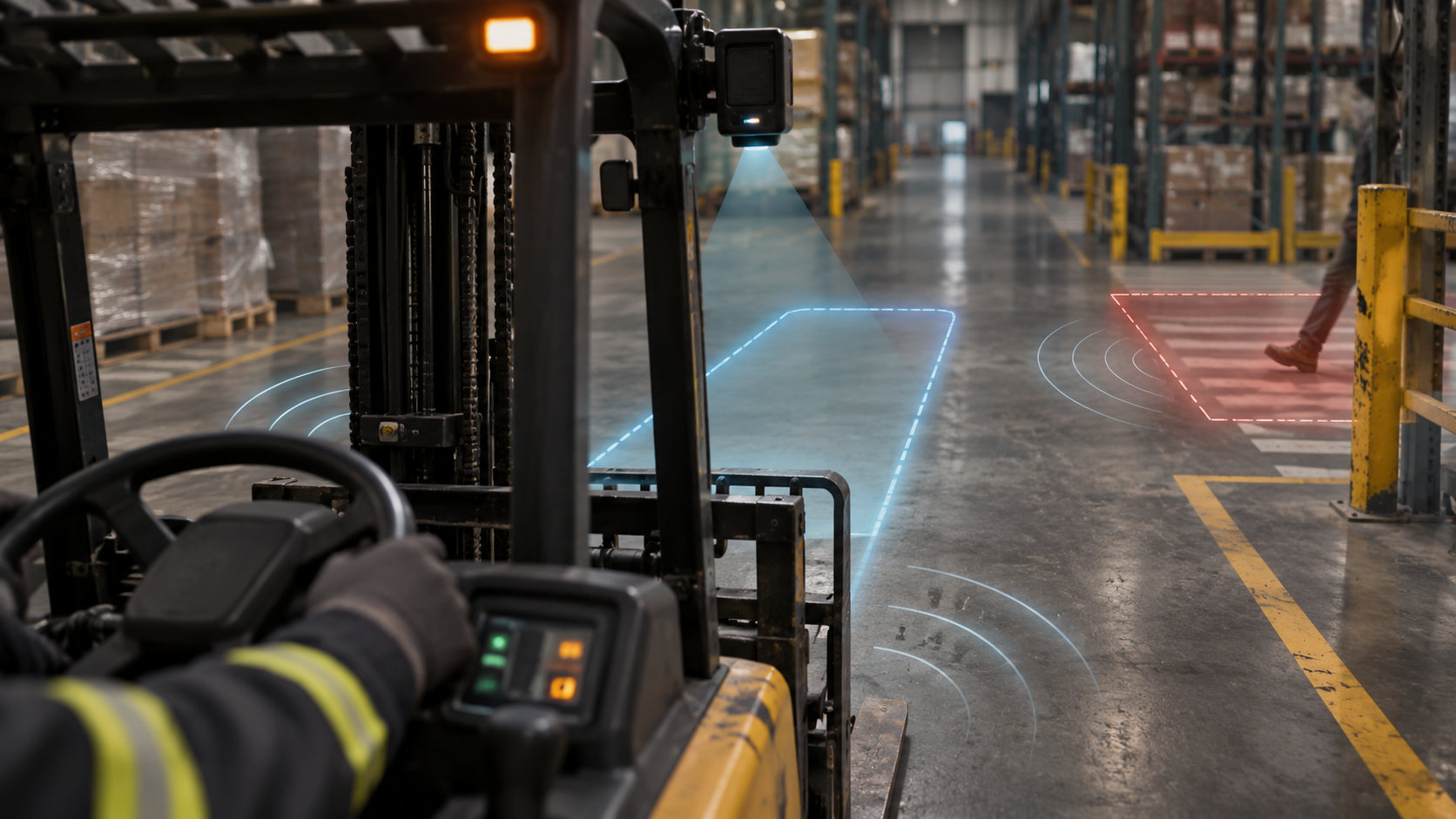
Forklift-Pedestrian Safety Technology: Match the Safeguard to the Risk
Planning for how forklifts operate safely around pedestrians depends not only on your workflow, but also your facility’s set up.
At one warehouse, forklifts can regularly approach an intersection where tall racking blocks the operator’s view of pedestrians.
At another, employees and delivery drivers may move through an active loading area, sometimes entering forklift travel paths without warning.
Both organizations may desire to improve their pedestrian safety, but the risks are different. This could mean the same technology may not be the best solution for both scenarios.
“When customers ask us about pedestrian safety technology, we first need to understand what’s creating the risk,” says Jeff Buyck, chief technology officer at Burwell Enterprises. “Then we can separately look at which safeguards make sense for that operation.”
For warehouse and fleet managers evaluating forklift-pedestrian safety technology, that means understanding what different systems can detect, how they respond to hazards, and where they may have limitations.
Start with where pedestrians and forklifts come into conflict
Before evaluating technology, look at how people and equipment move through your facility.
Are pedestrians crossing forklift travel lanes at blind intersections? Do employees regularly work alongside moving equipment? Are forklifts entering busy pedestrian areas at speeds that leave operators too little time to react?
Each situation may require a different combination of safeguards.
Start by identifying the locations where pedestrian and forklift traffic intersect, visibility is restricted, or movement is difficult to predict. Observe those areas during normal operations and busy shifts to understand how the risks arise.
Physical separation should be the first consideration wherever practical. The Occupational Safety and Health Administration (OSHA) recommends separating forklift and pedestrian traffic where possible, using designated walkways, barriers, and other traffic controls.
Where shared traffic can’t be eliminated, technology can provide additional ways to warn people, improve visibility, or influence forklift operation.
Which forklift-pedestrian safety technology fits the risk?
Several technologies can help address pedestrian safety, but their capabilities aren’t interchangeable.
Use the following scenarios to narrow down what may be appropriate for your facility.
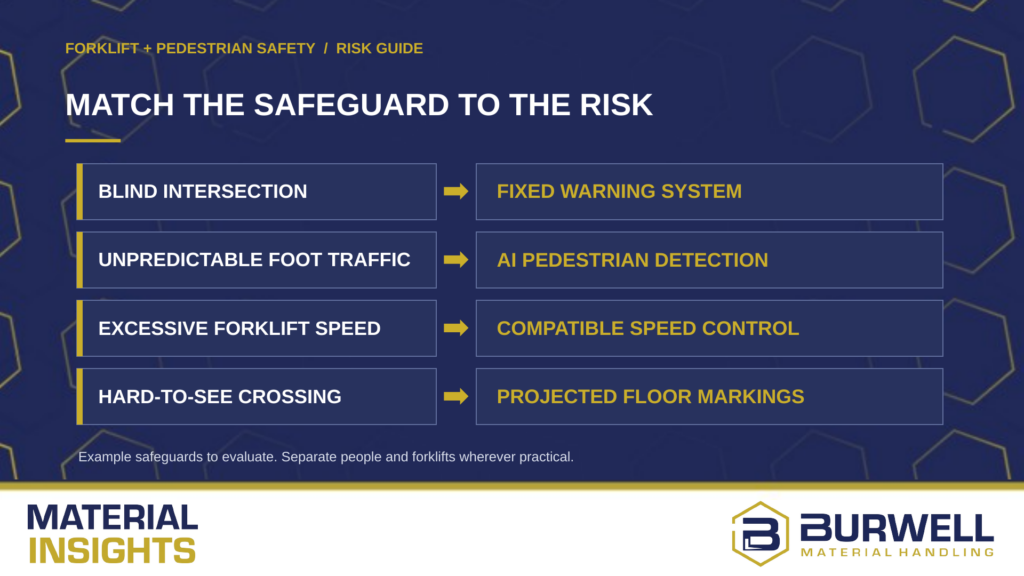
| Risk to address | Safeguards to consider | What to keep in mind |
| Blind intersections | Fixed intersection warning systems, proximity detection, speed controls, projected floor markings | A truck-mounted camera may not see pedestrians hidden behind racking |
| Unpredictable pedestrian traffic | AI pedestrian detection, wearable proximity alerts | Wearable-based systems generally require pedestrians to carry a compatible device |
| Excessive forklift speed | Location-based speed controls, compatible operator-assist systems | Warning systems don’t necessarily reduce truck speed |
| Poorly visible walkways and crossings | Projected floor markings, illuminated signs, warning lights | Visual markings don’t detect pedestrians or physically separate traffic |
| Recurring near-misses | Detection-event reporting, safety analytics, dashboard reporting | Data needs to be reviewed and used to improve operating conditions |
These options may complement one another, and none replaces the need for appropriate traffic controls and safe operating practices.
Let’s consider the blind intersection example.
If a forklift operator can’t see pedestrians approaching from behind a rack, an effective starting point might be changing the pedestrian route, improving sightlines, or creating a designated crossing. A fixed warning system could add an alert when traffic approaches the intersection.
Where excessive speed compounds the problem, compatible zone-based controls may provide another layer of protection.
The right combination depends on how the intersection is used, what people and equipment need to do there, and which risks remain after physical and operational changes.
What can pedestrian detection systems actually detect?
One important distinction is how different systems recognize potential hazards.
Various forklift pedestrian detection systems may operate differently and offer different types of protection.
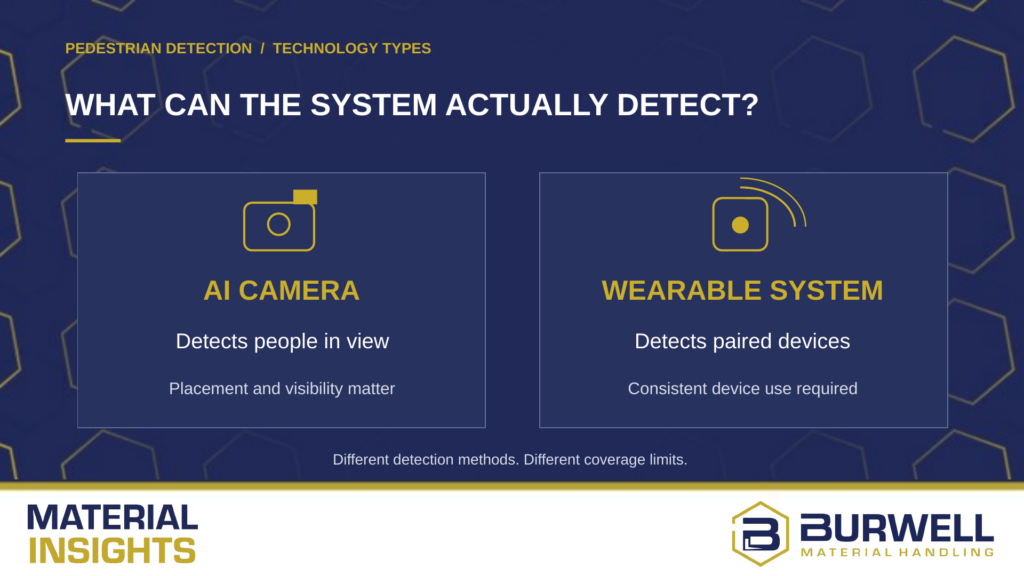
AI camera systems
AI-enabled cameras can identify pedestrians within their configured detection areas without requiring people to wear a special device. Depending on the system, they can provide audible or visual alerts when someone enters a defined danger zone.
These systems may be useful where visitors, delivery drivers, or other pedestrians move through an area unpredictably.
However, the camera systems’ effectiveness depends on placement, field of view, lighting, environmental conditions, and system configuration.
Wearable proximity detection
Some proximity systems use devices carried by pedestrians and sensors or transmitters installed on forklifts to identify when people and equipment are approaching one another.
Depending on the technology, these systems may provide warnings even when a pedestrian is outside the operator’s direct line of sight.
But wearable-based detection depends on people having and consistently using the appropriate devices. That’s an important consideration for facilities with visitors, contractors, or changing pedestrian traffic.
Warnings vs vehicle intervention (or both!)
Another distinction is what happens after a potential hazard is detected.
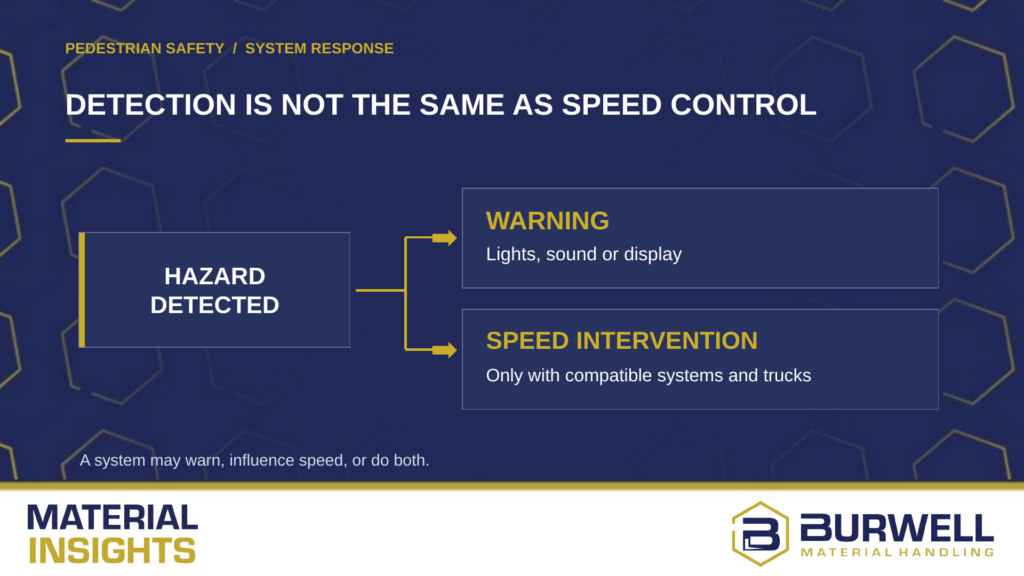
Some systems notify the forklift operator through lights, sounds, or displays. Others can also influence truck operation under specified conditions.
When comparing options, ask three questions:
- Who receives the warning? The forklift operator, the pedestrian, or both?
- What triggers it? A detected person, an approaching forklift, or entry into a designated zone?
- What happens next? Does the system issue a warning, limit speed, or provide another form of intervention?
Understanding those differences helps you evaluate what protection a particular system can provide in your facility.
How do you know the safeguard will work in your operation?
Even when a technology appears well suited to a specific risk, its effectiveness depends on how it’s installed, configured, and used.
“You want to see how the technology performs in the conditions your people and equipment encounter every day,” Buyck says. “The settings, the alerts, and how operators respond are all important to making it work.”
For example, Buyck says the most common mistake customers make when evaluating pedestrian-detection technology specifically is selecting a system that doesn’t provide multiple configurable detection zones and doesn’t provide outputs to integrate into other alerts through slow down or audible beacons.
Therefore, he recommends that before you roll out a new system across your facility or fleet, consider testing it at a pilot location or on a subset of forklifts.
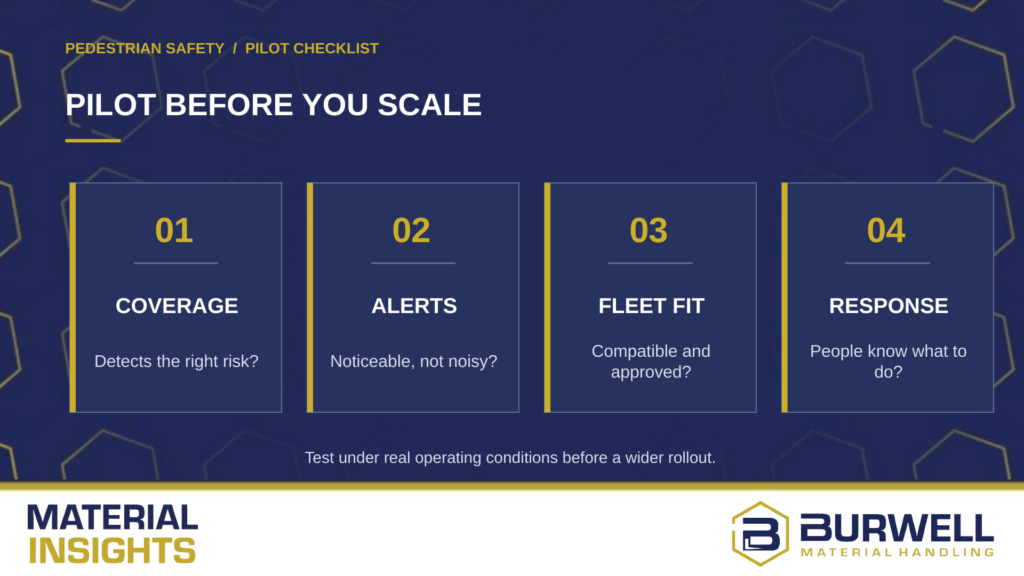
The evaluation should address four areas.
Detection and coverage. Does the system recognize the intended hazards under normal operating conditions? Test realistic pedestrian movement, forklift approaches, and visibility limitations.
Alert effectiveness. Are warnings noticeable and understandable without creating excessive nuisance alerts? A system that repeatedly warns operators about situations that pose little risk may become distracting or encourage people to disregard warnings.
Equipment compatibility. Will the solution work with your existing forklift models, including a mixed-brand fleet? Verify installation requirements and manufacturer approvals, particularly for systems that interface with vehicle controls.
Operator and pedestrian response. Do employees understand what the alerts mean and what action to take? Are they continuing to follow traffic rules and safe operating practices rather than relying on the system to prevent a collision?
It’s also important to establish how you’ll evaluate results.
Depending on the technology, that might include reviewing detection events, observing traffic behavior, tracking reported near-misses, or identifying areas where unsafe interactions continue.
The goal is to determine whether the safeguard is helping reduce the specific risk it was selected to address.
Start with your highest-risk interactions
You may have several areas where pedestrians and forklifts share space, but they won’t all require the same safeguards.
A blind intersection might call for changes to traffic flow and an additional warning system. An active staging area may benefit from pedestrian detection. A busy production zone might require stronger speed controls.
Start with the locations where the risk is greatest. Understand the conditions creating it, evaluate which safeguards address those conditions, and test how well they work before expanding.
Next step
Not sure which safeguards fit your facility’s pedestrian and forklift traffic risks?
Burwell Material Handling can help evaluate your operating conditions, identify appropriate safety technology capabilities, and determine where to start improving protection for people working around your equipment.