
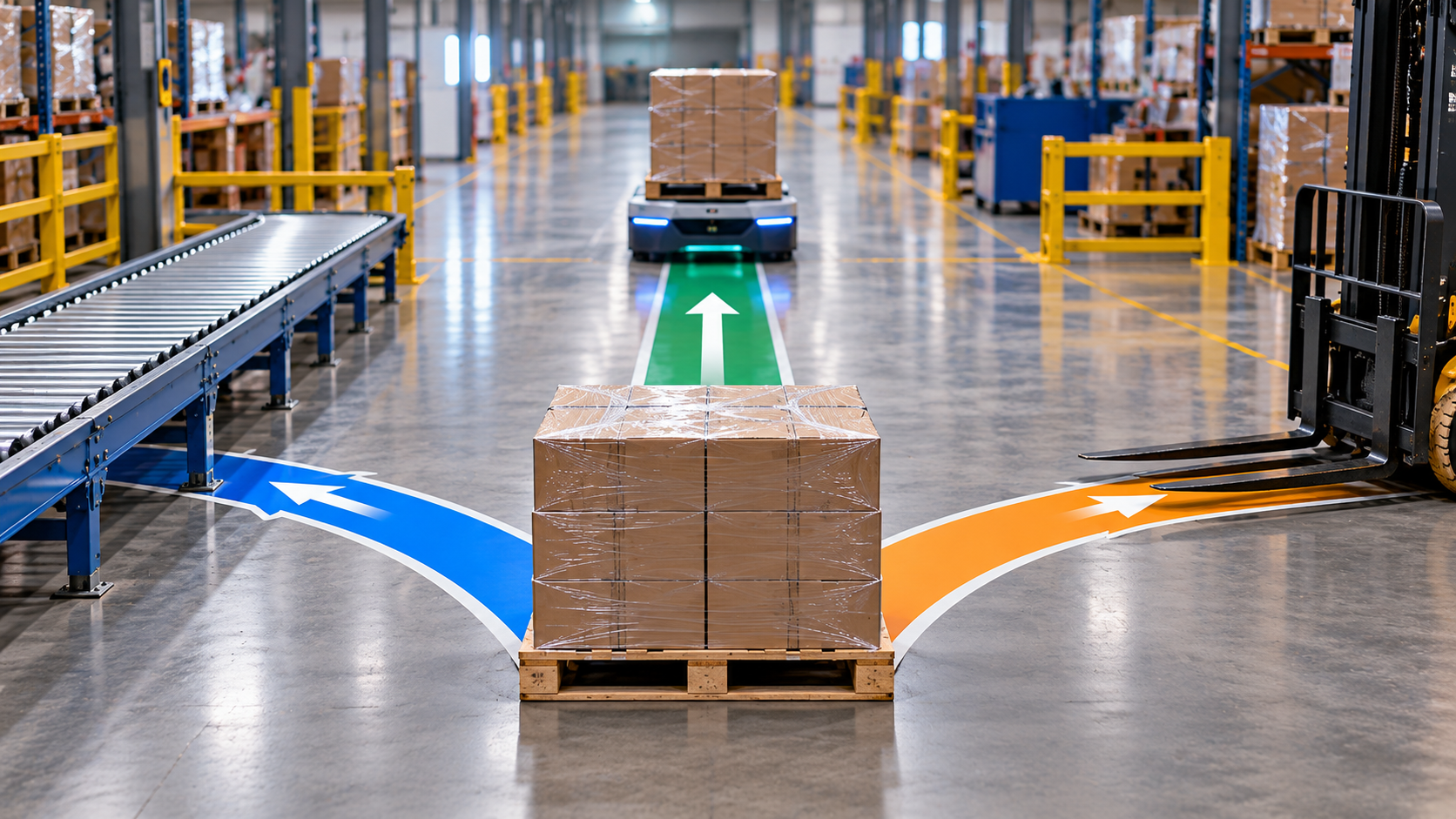
Conveyor, Robot, or Forklift? How to Choose the Right Way to Move Material Between Work Zones
When material needs to move from one part of your warehouse to another, it is tempting to start by evaluating what equipment you’ll need.
Stephen Leu, business development manager for Burwell Material Handling’s Engineered Solutions team, recommends starting somewhere else:
Define the movement first.
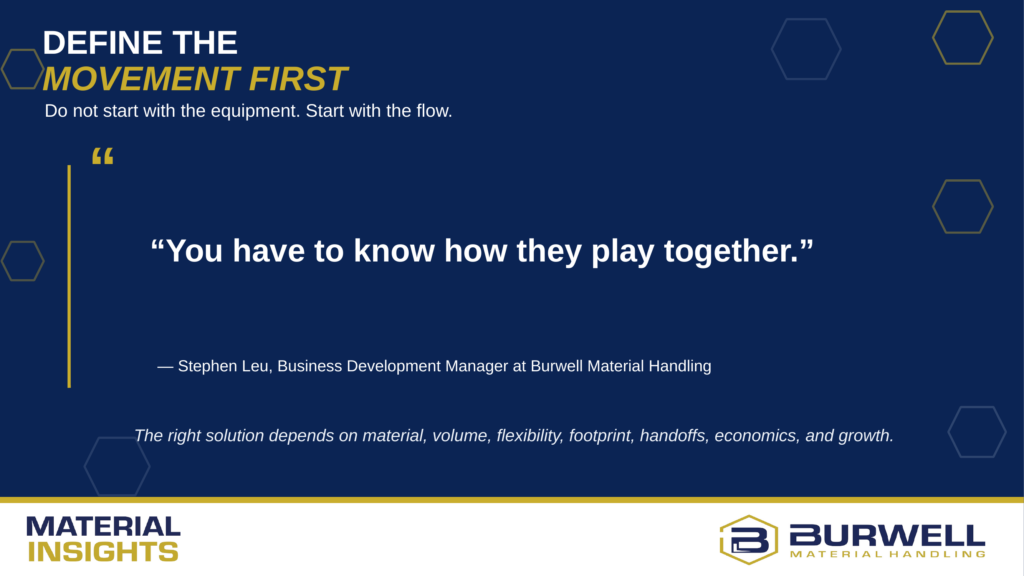
Leu says the right solution depends on what is being moved, how quickly it needs to move, whether the route changes, how much floor space is available, and what happens immediately before and after that movement.
That changes the conversation from “Which technology or equipment do we want?” to “What does this material flow actually require?”
Define the movement before you choose the technology
Leu says to start with the material itself.
“If you’re dealing with pill bottles, that’s a whole different scope of solutions and what is feasible than talking about 12-ft.-long coils that probably weigh 100 lbs. each,” he says.
After that, then move to defining the flow around it:
- What are the dimensions and weight?
- Is it a tote, case, pallet, cart, or unusually shaped load?
- How many moves are required per hour?
- Where does the movement begin and end?
- Can the destination change?
- How much floor space is available?
- What feeds this movement?
- What has to happen next?
- What throughput must the total system support?
Those details can eliminate potential solutions quickly.
For example, Leu says he once had a customer exploring automated trailer loading for unusually long pallets. The pallet dimensions created limitations for automated vision systems, while the required throughput and available footprint created additional tradeoffs for automated vehicles. Conveyors had strengths elsewhere in the process, but could not perform the trailer-loading task itself.
He says there was no single technology that solved every part of the problem, so the solution was a combination of technologies for different parts of the process.
Use flexibility, throughput, and the load to narrow the choices
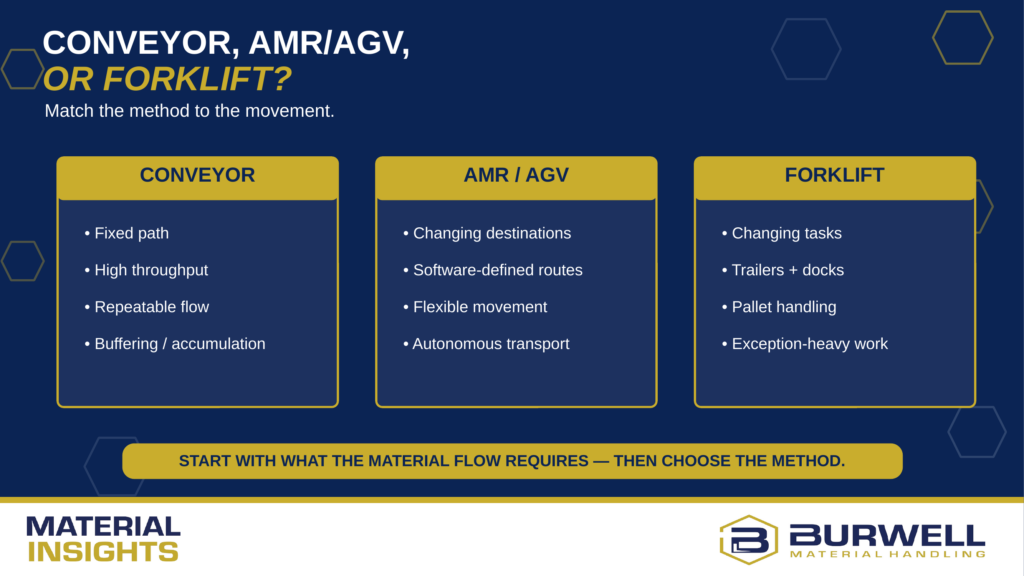
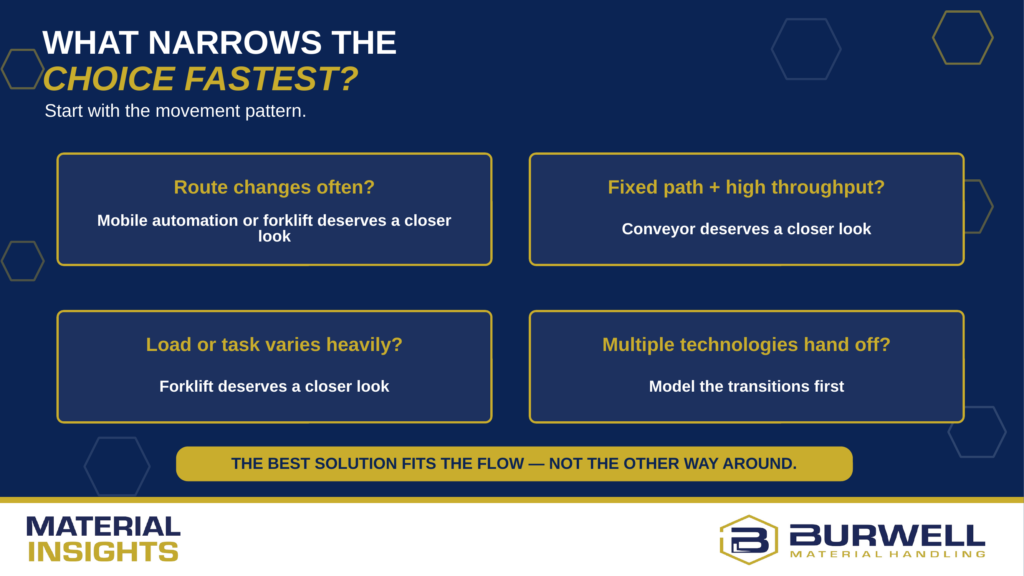
Conveyor: When the path can stay predictable
Determining the type of pick path you need is the first step, Leu says.
“Flexibility probably is the primary driver,” he says. “If you need flexibility on different destination types, conveyors are not your choice. Conveyors are for set routes.”
That rigidity can be a strength when the process itself is stable.
Conveyors deserve a closer look when material repeatedly travels between known points, the load profile is consistent, throughput is high, and the facility can dedicate permanent floor or overhead space to that path.
It can also be designed to accumulate or buffer product when downstream processes need a controlled release of material.
In fact, conveyors can potentially move so quickly that Leu says the system may need intentional buffering upstream so the next part of the process does not starve.
AMRs and AGVs: When the destination needs flexibility
Mobile automation becomes more compelling when pickup or drop-off locations need to change.
“AGVs or AMRs, you can make a simple switch inside your software and modify settings and destinations,” Leu says. “That’s easy to do.”
That flexibility comes with tradeoffs.
Depending on the application, automated vehicles may require more maneuvering footprint, may move more slowly than fixed conveyance, and still have physical limitations around unusual loads or specific tasks.
Forklifts: When the work itself keeps changing
A conventional forklift remains useful when the same piece of equipment needs to perform varied tasks, move between changing origins and destinations, work in trailers or docks, put away and retrieve pallets, or respond to exceptions that are difficult to design into a fixed system.
Leu says often, you’ll see the technologies and equipment work together at transition points of the process:
“You might use conveyors to eventually build a pallet that a forklift will move,” he says.
In this case, the forklift’s value is its ability to take over once the material reaches a different form or work zone.
The right answer may be a system, not a single technology
A building may use several different movement technologies, so Leu says you need to know where the strengths of one technology can compensate for the limitations of another.
For example, in one operation, conveyors could position pallets at fixed points, reducing the distance and footprint an automated vehicle needed to navigate. AGVs could then focus on moving the pallet into the trailer.
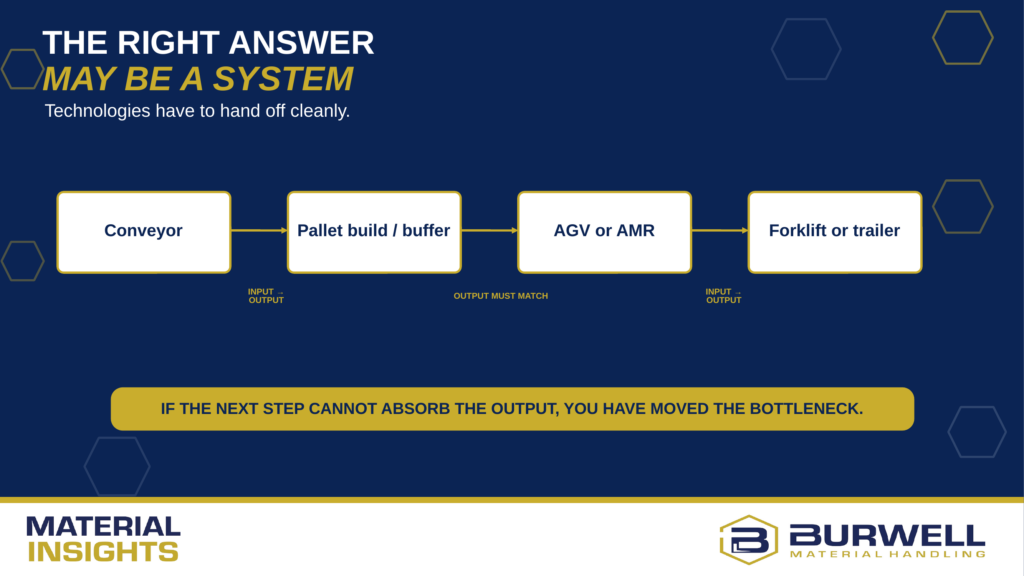
“You have to know how they play together,” Leu says.
And the handoffs matter just as much as the individual machines.
“Anytime that you’ve got a transition, you’ve got to think of inputs and outputs, and they have to match,” he says.
- If a conveyor delivers 100 units per minute to a process that can only handle 70, the extra conveyor speed has not improved the operation. It has created a bottleneck.
- If an AMR delivers pallets faster than operators can unload or process them, the queue simply moves.
- If a forklift brings material to an automated cell inconsistently, the automation may sit idle.
That is why improving material movement requires looking at the full flow and being careful not to create a new constraint by making one step faster than the next one can absorb.
Let the problem and the economics decide
Technical fit is only one part of the decision, Leu says.
Cost, available capital, operating model, growth expectations, and the useful life of the solution can all affect which path makes sense.
Leu says he had one customer that was comparing a large fixed automation investment with robotic arms available through a Robots-as-a-Service model. The fixed system required significant upfront capital. The RaaS model lowered the initial commitment and shifted more of the cost into ongoing operations.
He says the solution may fit, but it still needs to make sense for the business, and the system needs enough headroom to support future demand. Different automation technologies trade throughput, density, cost, and flexibility differently; choosing a system that reaches its capacity ceiling too quickly can undermine the value of a major capital investment.
That is especially important in an existing facility, where a brownfield improvement plan must account for the current workflow, transition, footprint, and infrastructure — not just the finished technology.
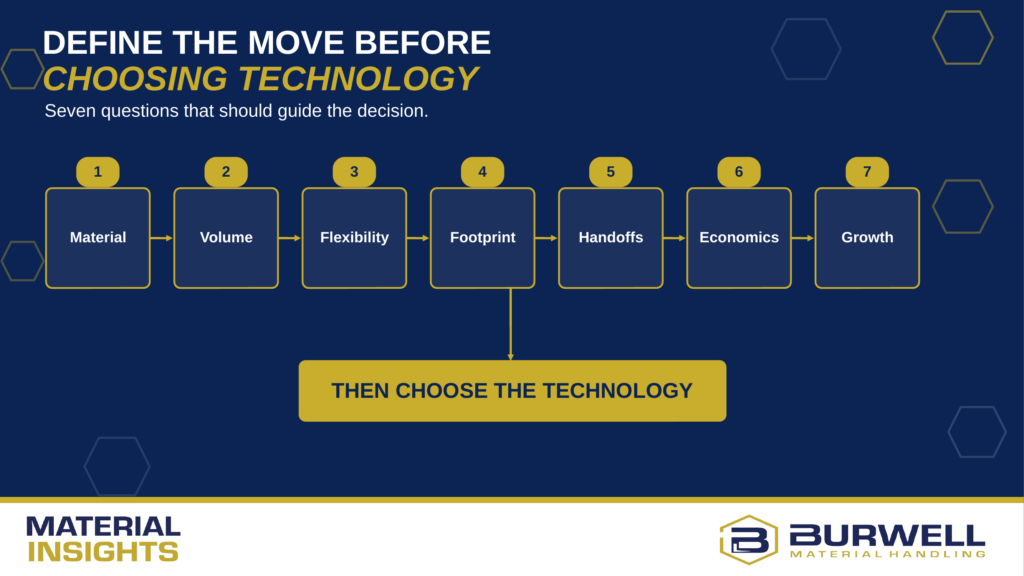
Before choosing how material should move:
- Material: What exactly are you moving?
- Volume: How much needs to move, and how fast?
- Flexibility: Will origins, destinations, or routes change?
- Footprint: How much space can the solution consume?
- Handoffs: What feeds the movement, and what receives it?
- Economics: What investment and operating model makes sense?
- Growth: Will the solution still support your requirements several years from now?
You do not need to know which technology answers those questions before you call your material handling solutions provider for help.
In fact, Leu says customer conversations are roughly split between organizations that arrive with a very defined technical idea and those that say, in effect, tell us what you think is right, explain why, and show us the economics.
That is where an experienced systems integrator can understand the movement well enough to know which technology or equipment to recommend is the right one for your operation.
Next step
If your operation is evaluating how material should move between work zones, contact the Burwell Material Handling team of experts to help map the flow, compare the available technologies, and build a solution around the work rather than around a product.