
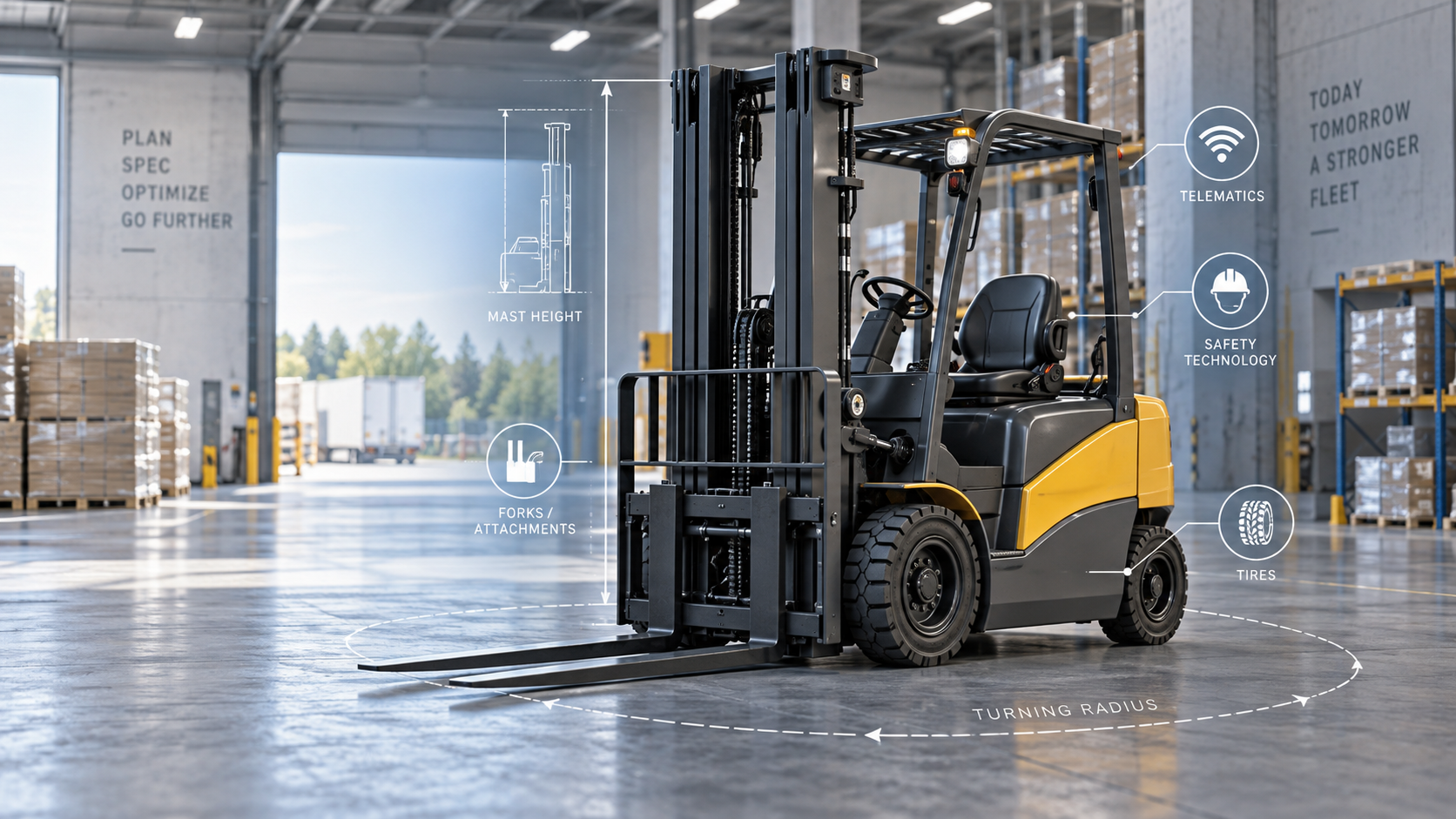
Future-Proofing Your Forklift Fleet: Spec Choices That Reduce Damage, Downtime, and Regret
A forklift can run exactly as designed and still not be the ideal truck for your material handling operation, especially when circumstances change.
While some changes can be relatively easy to accommodate, others can turn into an expensive equipment problem.
“This is why you need to consider what work your truck will encounter in the months and years ahead,” says Chris McCauley, district director for Burwell Material Handling.
Future-proofing your forklift fleet means identifying those decisions early, without over-specifying every truck for possibilities that may never happen.
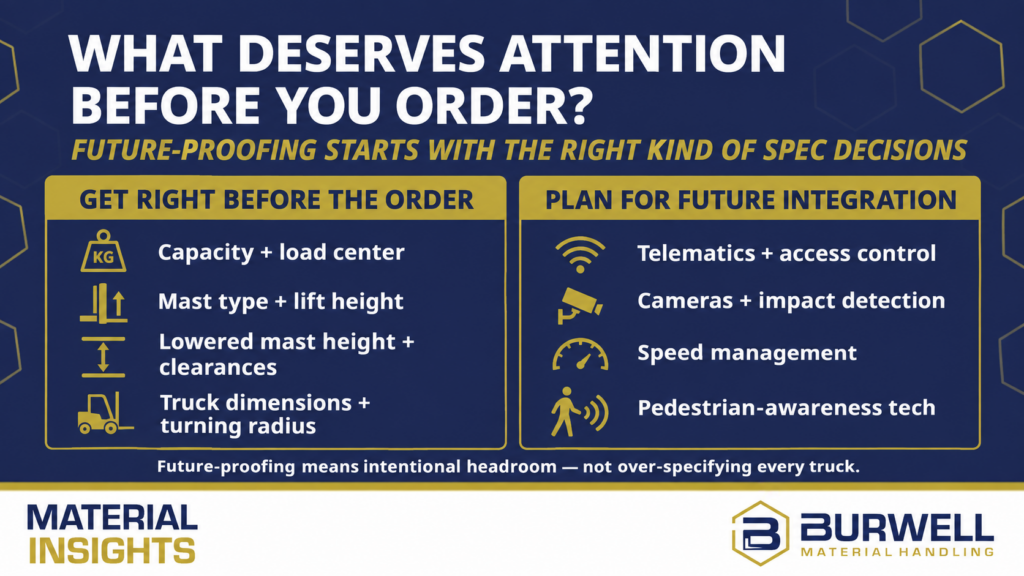
Get the hard-to-change specs right first
Start with the specifications that determine what the forklift can physically do.
Capacity, load center, load dimensions, mast type, maximum lift height, lowered mast height, overall dimensions, turning requirements, and overhead clearances all create boundaries around the future application.
If your next warehouse phase may add taller racking, for example, the lift height deserves a closer look now. If loads have gradually gotten heavier or longer, capacity and load center assumptions from the current fleet may no longer be appropriate.
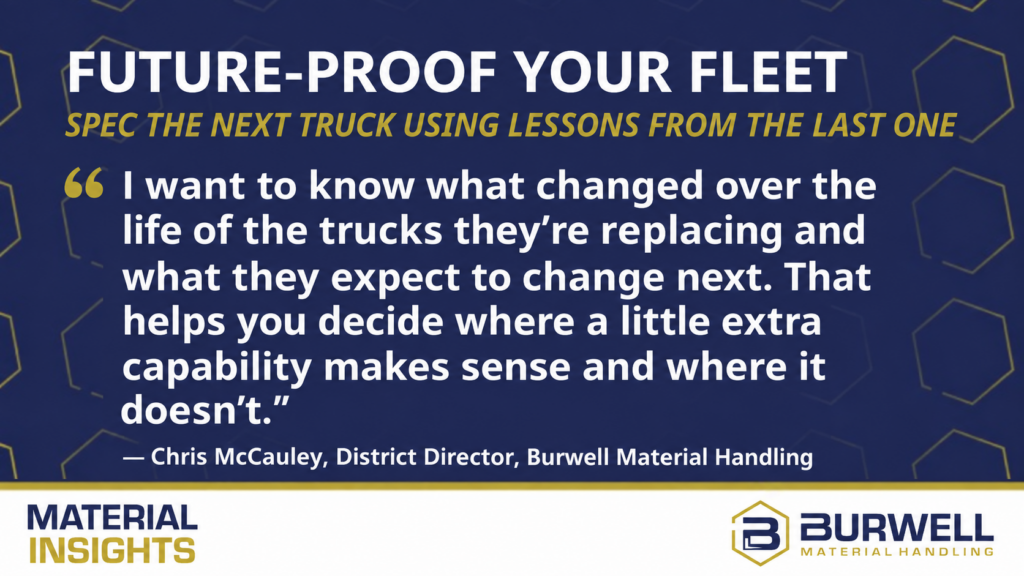
“When I’m helping customers with their equipment decisions, I want to know what changed over the life of the trucks they’re replacing and what they expect to change next,” McCauley says. “That helps you decide where a little extra capability makes sense and where it doesn’t.”
Spec for the conditions that actually create wear
A forklift’s toughest recurring hour of a shift should greatly influence its specs.
If a truck spends 80% of its day on smooth concrete but the other 20% on harsh conditions that repeatedly wears tires or stresses components, that 20% matters.
“Look at the part of the route that challenges your current trucks,” McCauley says. “If you keep damaging tires, beating equipment up on rough surfaces, or having issues in a certain environment, that history should be part of the next spec.”
That may influence tire choice, ground clearance, environmental packages, power source, or whether one forklift should even be expected to handle all of those applications.
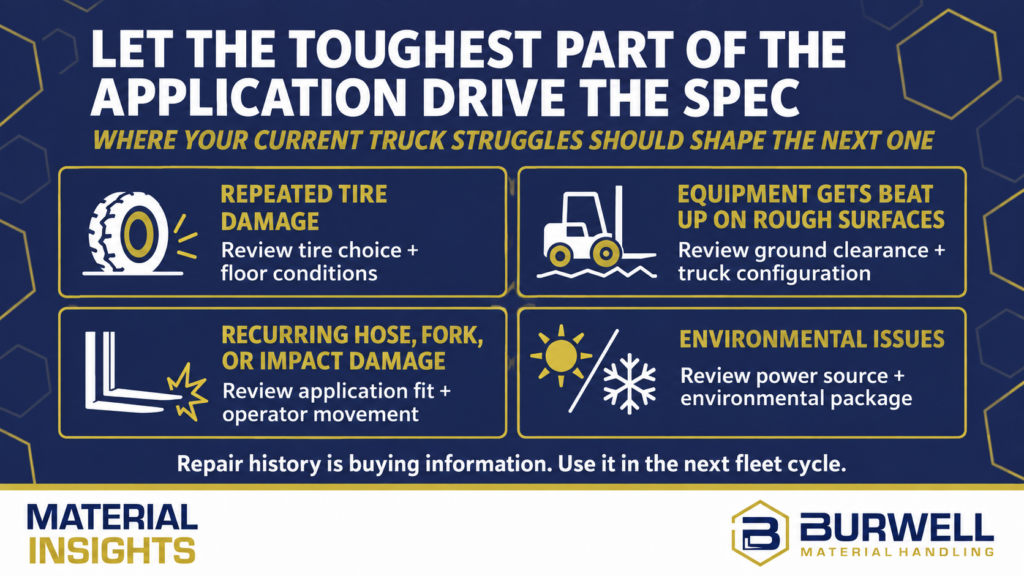
This is also where repair history becomes valuable buying information.
A repeated tire failure, damaged hose, bent fork, or recurring impact should not disappear from the conversation once it is repaired. Patterns can point to application fit, operator behavior, layout, or equipment specifications that should change in the next fleet cycle.
Use attachments and controls to avoid problems
Future-proofing is not just about capacity and chassis choices.
Sometimes certain specs and options can eliminate inefficient or damaging movements that operators perform hundreds of times.
- A side shifter allows operators to adjust load position without repeatedly moving the entire forklift.
- Fork positioners let operators change fork spacing from the cab instead of manually repositioning forks.
- Properly matched clamps and specialty attachments can improve load handling and reduce damage for applications that standard forks do not handle well.
“A side shifter, fork positioner, or the right attachment may look like another option on the quote,” McCauley says. “In the right application, it can extend the life of the machine and avoid problems or repairs.”
Operator-assist features can serve a similar purpose.
Programmable performance settings, cameras, height indicators, automatic fork-leveling aids, or rack-height controls may help make repeated work more consistent. Some current reach-truck technologies, for example, are designed to automatically stop at programmed heights or assist with fork positioning to reduce product, rack, and equipment damage.
The key is to start with the problem rather than the option list:
- Where does product damage occur?
- Where do operators repeatedly reposition the truck?
- Which task creates the most near-misses or impacts?
- Where does precision fall apart late in the shift?
Then evaluate whether an equipment feature can remove that friction.
One important note: forklift attachments can affect residual capacity and require proper configuration and data-plate updates, so they need to be evaluated as part of the overall specification.
Leave room for the fleet to get smarter and easier to support
Fleet specifications also affect how easily equipment can adopt technology and how complicated the fleet becomes to maintain.
If you already know the operation is moving toward telematics, operator access control, impact detection, cameras, speed management, or pedestrian-awareness technologies, include those plans in the equipment conversation.
You may not need every technology on day one. But knowing what you want to integrate later can influence the platform, wiring, controls, and options you choose today.
“If you already know you plan to continue to add fleet technology down the road, bring that into the spec conversation at the beginning,” McCauley says. “Planning for it early usually gives you more flexibility.”
Future-proofing also means thinking about commonality across the fleet.
Unnecessary variation in controls, battery systems, attachments, tires, and common service components can add complexity to operator training, parts inventories, maintenance, and fleet management.
“You don’t need every truck to be the same,” McCauley says. “But where you can create commonality without compromising the application, it can help you make training and support a lot simpler.”
Run the regret test before you order
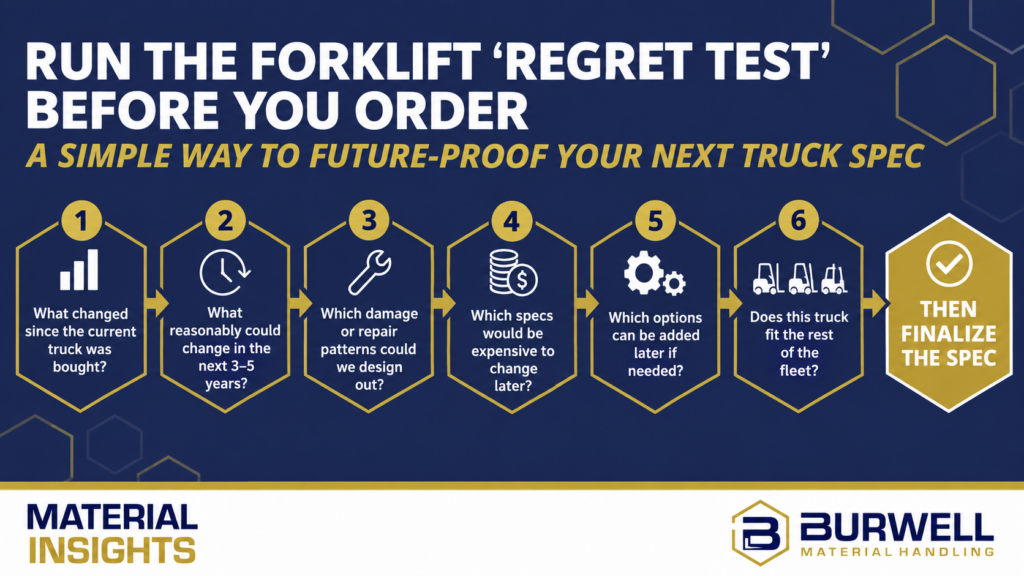
Before finalizing the spec, ask:
- What has changed since we bought the truck this one is replacing?
- What reasonably could change during the next three to five years?
- Which recurring damage or repair patterns could we design out?
- Which specifications would be expensive to change later?
- Which options can realistically be added later if the need develops?
- Does this truck fit cleanly into how we operate and support the rest of the fleet?
“Good spec work should keep you from having the same conversation two years from now about why the truck no longer fits,” McCauley says. “Look at what hurt the last fleet, what’s changing in the operation, and make those lessons part of the order.”
In essence, future-proofing is about learning from the fleet you already have and making the next equipment decision with fewer blind spots.
Next step
Before replacing or adding a forklift, review the application, repair history, operating environment, and expected growth with your Burwell Material Handling team of experts.