

How to Automate Your Warehouse in Stages
A lot of warehouse teams ultimately want automation, but they don’t know how to start.
Stephen Leu, business development manager for Burwell Material Handling’s Engineered Solutions team, says a staged approach keeps risk low, builds confidence, and helps you prove ROI before scaling.

“Of course, it all depends on the customer’s appetite, their operation size, and budget, timeframe, and growth expectations,” Leu says. “All of that plays into how hard we jump into the first stage.”
Here are the four stages Leu says he recommends material handling operations roll out.
Stage 1: Start with stability before speed
First, you need to make sure all your warehouse essentials are functioning as they should.
This stage removes friction from receiving, storage, pick paths, and dock flow so the building can support higher throughput without chaos. It’s also where quick wins often live.
“Always start by first addressing easy and low-hanging fruit,” Leu says.
Stage 2: Pick a problem area and win
Choose one area (often picking, sortation, or shipping) and prove measurable improvement.
“This is the criteria you need to move forward: Here’s the data that we have, here’s the problem to solve, and here’s how big the problem is,” Leu says.
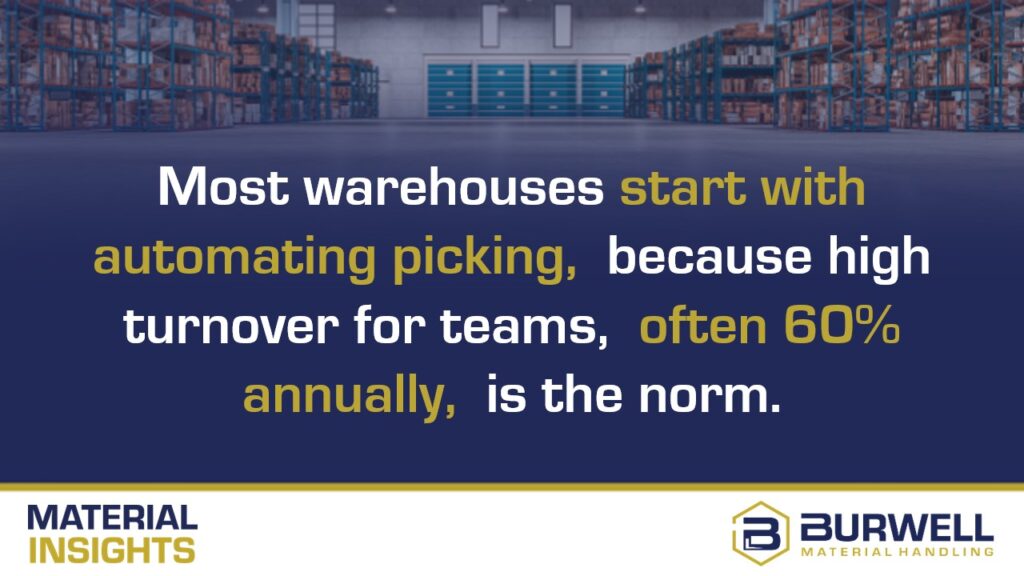
He says where most warehouses start is with picking, because high turnover – often 60% annually – with teams is the norm.
A useful way to compare solutions in this stage is a structured set of options, so trade-offs are visible early.
“Examine good, better, best scenarios as you evaluate solutions,” Leu says.
Stage 3: Scale what works
After a win, the temptation is to roll the same solution everywhere. Instead, revisit bottlenecks, because fixing one area often reveals the next constraint.
For instance, if pack stations were the area you’re targeting with automation, your pick stations will most often be the next problem.
If you can’t tackle both at the same time, have a plan for what you’ll do in the interim and how to budget to address in the future, Leu says.
Stage 4: Make the transition plan the focus
Installing a new automation system is one challenge. However, Leu says you also need to think about keeping your workflows and output stable while undergoing change.
“A project lives or dies by its transition plan,” Leu says. “If you don’t have a good plan, the whole project can go up in flames.”
Because operations can’t stop during an installation, you need to consider that as part of the overall decision and how the transition to automation can happen as seamlessly as possible.
As your organization weighs automation solutions, Leu says you should work with a partner that helps you navigate these stages
Ready to evaluate automation solutions for your warehouse? Talk to a Burwell Material Handling expert today.