How to Build a Forklift Forks and Chains Inspection Program That Prevents Downtime
Implementing a forklift forks and chains inspection program is the key to preventing safety-critical failures and costly downtime.
But how should your organization do it? And what points should a robust forks and chains inspection program contain?
“It’s up to us as qualified service technicians to bring awareness and help educate our customers on what’s required,” says Tony Jennings, technical training manager at Burwell Material Handling.
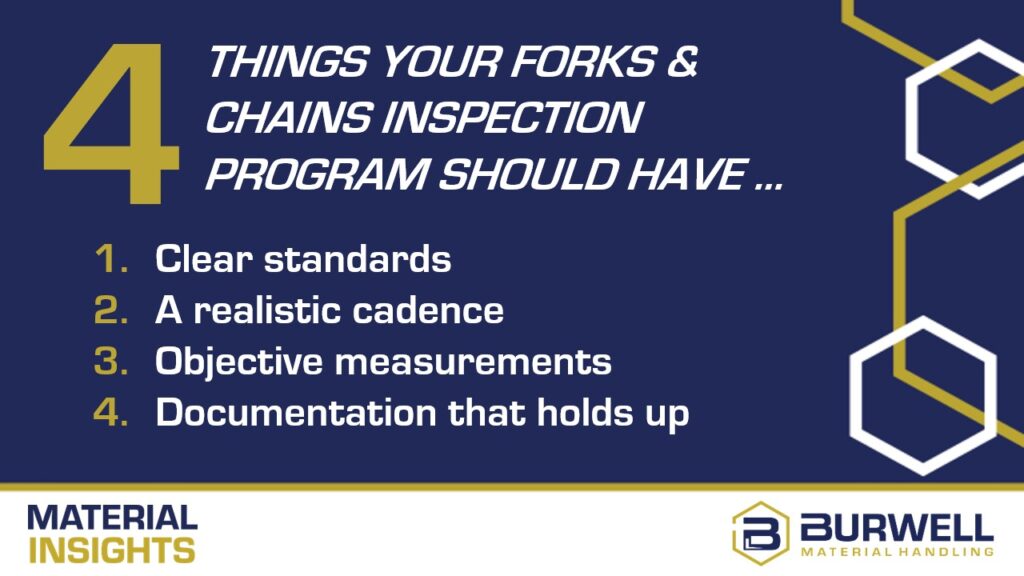
A good forklift forks and chains inspection program shouldn’t be complicated, just consistent. It needs to have clear standards, a realistic cadence, objective measurements, and documentation that holds up.
Step 1: Set the standard
Start by defining your process and what wear thresholds trigger removal from service. Work with your dealer and service technicians to follow manufacturer guidelines.
Jennings says OSHA and ANSI standards require forks and chains to be inspected regularly.
From an industry best-practice standpoint, ANSI/ITSDF B56.1, the safety standards for forklift trucks, provides specific guidance for how forks in service should be inspected, including inspection intervals and defect criteria.
The standards require that forks in use should be inspected at intervals not more than 12 months for single-shift operations, with more frequent inspections for severe use.
Fork wear also has a clear, measurable “line in the sand.” According to the standards, if thickness drops to 90% of the original thickness, especially near the heel, the fork should not be returned to service and should be replaced.
Step 2: Build a cadence to reduce risk
According to OSHA 29 CFR 1910.178(q)(7), powered industrial trucks must be examined before being placed in service, and OSHA clarifies this examination is required daily, or after each shift for trucks used continuously.
At the same time, OSHA acknowledges that ANSI/ITSDF B56.1 includes more specific fork inspection procedures, even though those specific procedures are not adopted into OSHA regulation.
In other words: OSHA sets the baseline “inspect daily before use,” while ANSI provides the detailed “how” many fleets follow as best practice.
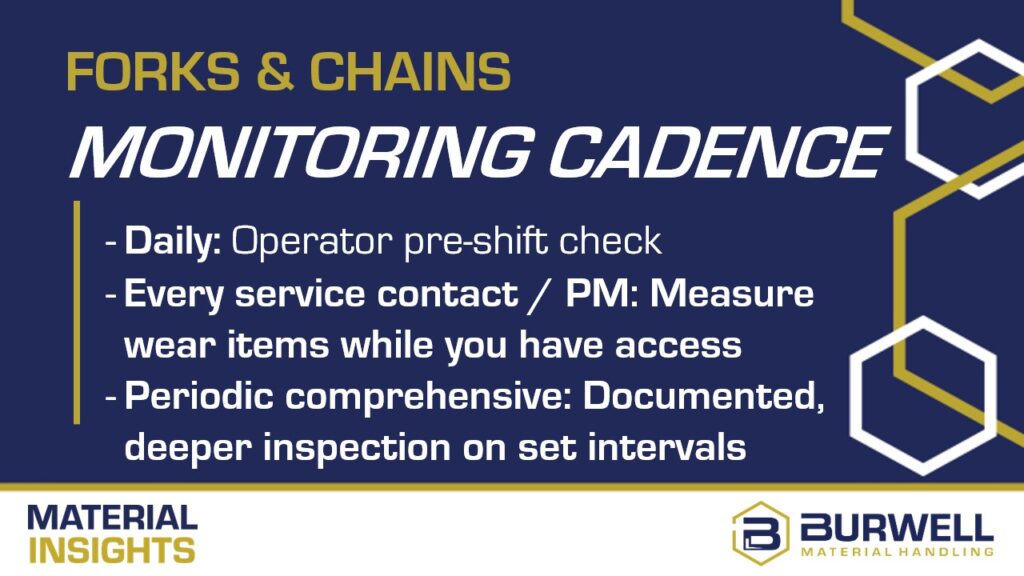
Here’s what a cadence for monitoring forklift forks and chains wear should look like:
- Daily: Operator pre-shift check (OSHA-required “before service” examination)
- Every service contact / PM: Measure wear items while you already have access
- Periodic comprehensive: A documented, deeper inspection on a set interval (tighten if your conditions are harsh)
For chains specifically, inspection frequency should be tightened based on environmental conditions (dust, debris, corrosion, outdoor exposure). Many programs also include a “full check” on a recurring interval (for example, at least every 6 months) so you’re not relying only on visual cues.
Step 3: Define what to look for with your forks and chains
Your program should separate visual checks from measured checks, Jennings says.
Here’s what your qualified service technicians should be monitoring with your forklift fork and chain wear:
Forks: Measure the heel
- Use a fork caliper / Go-No Go gauge
- Focus on the heel region where wear is most critical
- Use the 90% rule as the pass/fail threshold
Chains: Measure elongation and watch for failure indicators
These are key triggers for removal/replacement:
- Elongation >3% (reduces strength and warrants replacement)
- Protruding/turned pins, plate cracking, rust/corrosion, tight joints
Step 4: Make documentation part of the process
The difference maker in a solid forklift forks and chains inspection program is proper documentation. This improves accountability, accelerates approvals, and protects you after an incident.
“Anytime we do a PM, there’s a check sheet and those items should be documented,” Jennings says.
He recommends that if a technician notes a problem area with wear during an inspection, you have to record it and report it.
“Take a picture and communicate that with the manager and get his signature that you reported it,” Jennings says.
Your forklift forks and chains inspection program documentation should include:
- Inspection/PM checklist record
- Photo of gauge reading (fork heel, chain gauge)
- Notes on defect category and severity
- Corrective action plan + approval/sign-off
- Tag-out record if removed from service
Step 5: Decide what happens when a defect is found
A program fails when you don’t know the appropriate action to take when excessive wear is discovered.
Define your triggers and clearly communicate those to your team so they don’t have to make decisions in the moment.
If a measurement crosses a threshold or damage is detected, the default should be: stop work, tag out, evaluate, correct, document, return to service.
Next step
Need help building your forklift fork and chain inspection program? Contact the Burwell Material Handling team of experts today.