
How to Spec a Forklift Rental
When someone calls for a forklift rental, they often start with the number they know: “I need a 5,000-lb. forklift.”
But that alone is not enough to spec the right rental.
A forklift rental has to fit the job in the real world: the load, the lift height, the floor, the aisle, the dock, the work schedule, the operator, and the rental window.
“A forklift rental starts with the job that’s actually being done, not just the size of the truck,” says Matt Hicks, EVP of Burwell Rents. “We need to know what you’re moving, where it’s going, and what conditions the truck has to work in.”
If you leave out key details, the truck may be completely wrong for the work. Here’s what to know before you call.
Start with the load
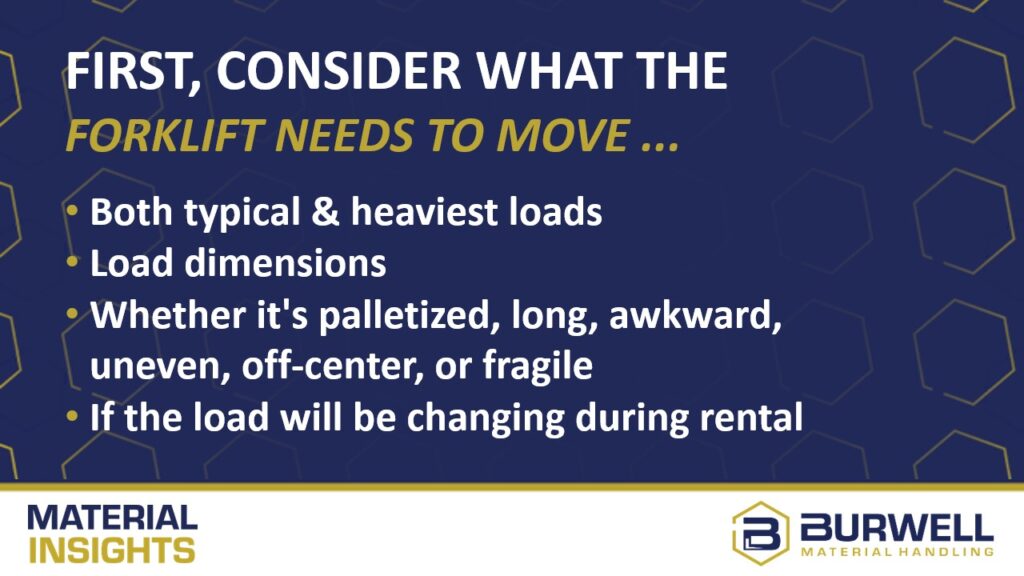
The first question is what the forklift needs to move.
That includes the heaviest load, the typical load, and the load dimensions. It also includes whether the load is palletized, long, awkward, uneven, off-center, fragile, or will be changing throughout the rental period.
Rated capacity matters, but it is not the whole story. A 5,000-lb. forklift rating does not automatically mean every 5,000-lb. load is safe or practical in every application.
“Weight matters, but shape matters too,” Hicks says. “A long or uneven load can change what truck makes sense.”
This is especially important when renting quickly to cover a down unit or peak demand. [A rental coverage plan is key to identifying rental specs] before a crisis occurs.
Know the height and clearance requirements
Before renting a forklift, you need to know the maximum lift height required for the job, as well as the lowered mast height and any tight entry points the truck needs to pass through.
“What often gets missed is whether the truck can get through the door or into the trailer,” Hicks says.
Lift height and clearance should always be discussed together, he says.
Match the truck to the actual work path
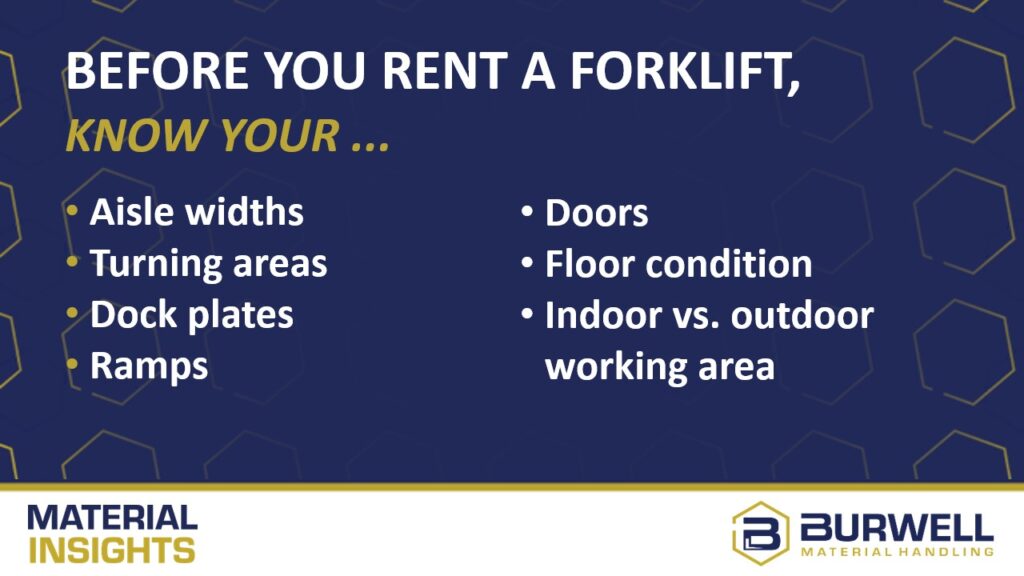
A forklift rental should be matched to the most challenging part of the work path. You need to know your aisle widths, turning areas, dock plates, ramps, doors, floor condition, and whether the truck will move between indoor and outdoor areas.
“Walk the path the truck has to travel,” Hicks says. “If it has to cross a rough yard or climb a ramp, that needs to be part of the rental conversation.”
Tire selection can be especially important. Cushion tires, pneumatic tires, and solid pneumatic tires are suited for different conditions. If the work path includes outdoor travel or rougher surfaces, that detail should be shared up front.
Choose a power source that fits the site and work
Electric, LP, and diesel forklifts each have a place. The right choice depends on the site and the work.
For indoor applications, ventilation, emissions, noise, and facility policies may matter. For outdoor work, runtime, terrain, fuel access, and weather exposure may matter more. For multi-shift work, battery runtime, charging time, charger availability, and charging location become part of the spec.
A rental can still create problems if the site cannot support the power source. An electric truck requires both a plan and infrastructure for charging.
Identify attachments before the rental is dispatched
Attachments can affect productivity, availability, and safe capacity. If the job requires specialty forks or another attachment, that needs to be part of the first rental conversation.
“If the attachment is part of how the work gets done, you need to note that upfront,” Hicks says. “That helps us match the truck and attachment together instead of trying to solve for it later.”
Not every attachment is available for every truck on short notice. If the attachment is critical, the rental provider needs to know that before dispatch.
Make sure the site and operators are ready
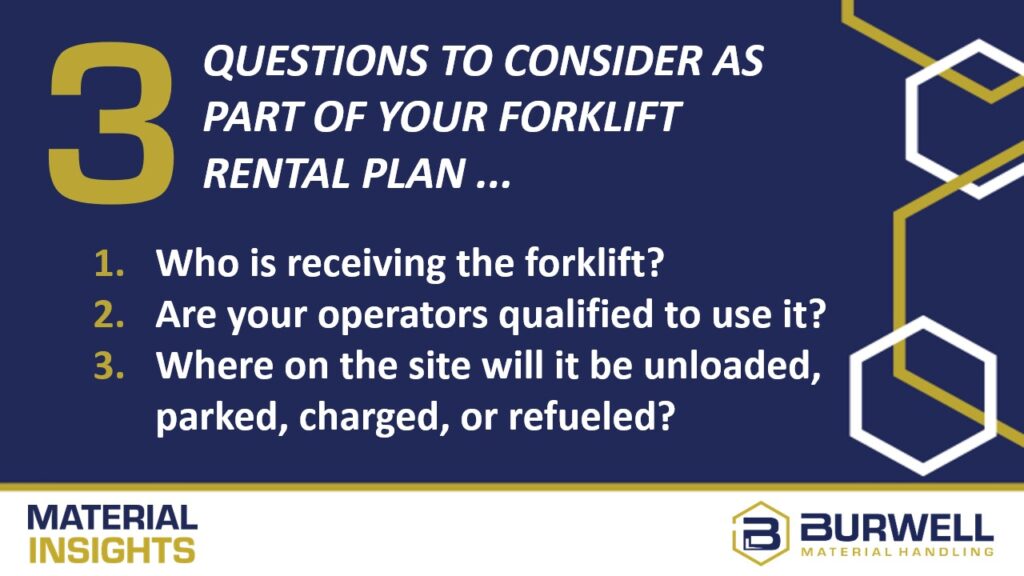
A rental is not solely about securing the right machine; it also needs a plan built around it. Hicks says considerations should include:
- Who is receiving the forklift?
- Are your operators qualified to use it?
- Where on the site will it be unloaded, parked, charged, or refueled?
Delivery access, work hours, gate instructions, PPE requirements, and site safety rules all affect how smoothly the rental starts.
Quick forklift rental spec checklist
Before you call for a forklift rental, be ready to answer:
- What are you moving?
- What does the heaviest load weigh?
- What are the load dimensions?
- Is the load standard, long, awkward, or off-center?
- How high does it need to lift?
- What doors, beams, trailers, or overhead obstructions matter?
- Where will the truck operate?
- What surfaces will it travel on?
- Will it go indoors, outdoors, or both?
- What power source can your site support?
- What attachments are required?
- How long is the rental needed?
- Who will operate it?
- When and where should it be delivered?
The more clearly you can describe the job the forklift will help handle, the better your rental provider can match the truck to the work.
Next step
If you need a forklift rental, contact your Burwell Material Handling rental team with the job details. We’ll help match the right truck to your load, site, schedule, and application.