
Why Your PMs are the Best Way to Reduce Forklift TCO
Picture this: it’s the start of your first shift, and one of your key forklifts goes down.
Now you’re scrambling. You have idle operators, backed-up docks, PLUS the cost of expedited parts and an emergency rental.
By the end of the day, that one breakdown has cost close to more than a year’s worth of routine maintenance, and your total cost of ownership just went up.

“Planned maintenance (PM) programs give you control of not only your fleet’s performance and uptime, but also over your total cost of ownership,” says Lindsey Coffman, key accounts manager at Burwell Material Handling. “By staying proactive with PMs, you’re making a small, strategic investment now to avoid larger, unexpected expenses later. It’s a proven way to protect both productivity and profitability.”
The best way to reduce forklift TCO? Set up a regular PM program — and stick to it.
Below is the simple math, the operational upside, and a quick plan to right-size your PMs so you can better manage your TCO.
How PMs Protect Your Bottom Line
Downtime is one of the most significant drivers of higher ownership costs.
“Every unplanned maintenance event multiplies expenses, from additional labor and rental equipment to shipping delays and missed production targets,” Coffman says. “Skipping a PM that costs less than $300 in fluids can quickly escalate into a $2,500+ engine repair.”
Routine PMs also help preserve asset value and lengthen replacement cycles, giving operations more life and return from every forklift in the fleet.
“When PM schedules slip, the true cost isn’t just the repair,” Coffman says. “It’s the disruption in your daily operations, the lost productivity, and missed commitments to your end users. That’s what truly damages your total cost of ownership.”
The Math: PMs vs. Reactive Repairs
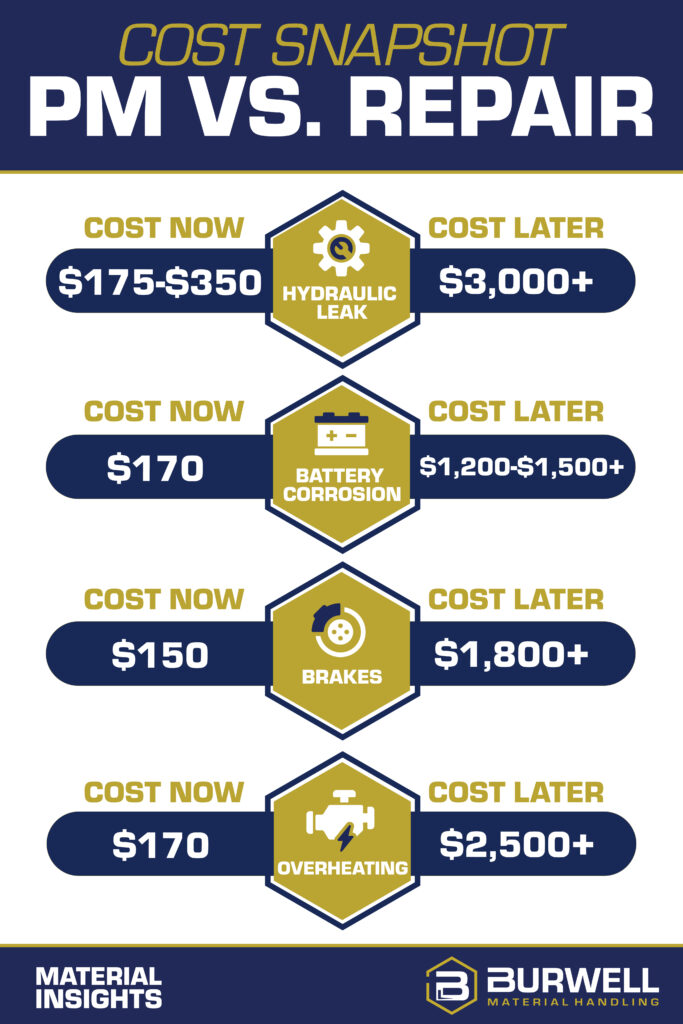
| Issue | Caught during PM | If you wait |
| Hydraulic leak | $175-$350 (repair) | $3,000+ (hoses & cylinders + downtime) |
| Battery corrosion/dead cells | ~$170 (inspect & clean) | $1,200-$1,500+ (replacement + lost shifts) |
| Flat/worn tires | ~$170 (early intervention) | $400+ per tire (plus safety risks) |
| Brake wear | ~$150 (pad swap) | ~$1,800 (rotors, calipers, downtime) |
| Overheating | ~$170 (fluids/fan check) | $2,500+ (engine rebuild/new radiator) |
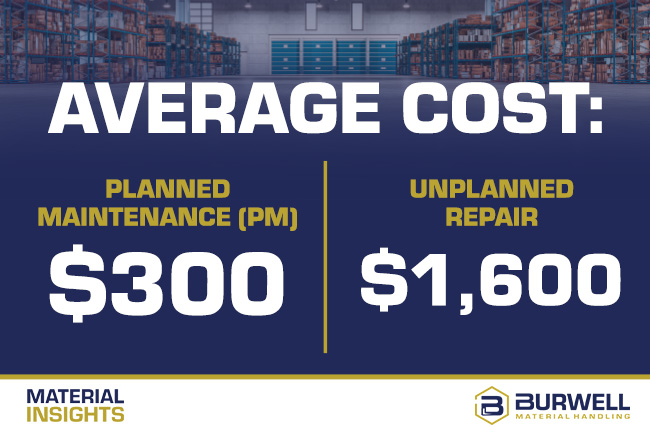
The numbers speak for themselves: a typical preventive maintenance (PM) visit averages around $300, compared to around $1,600 for an unplanned, reactive repair.*
“That’s a significant difference, especially when you multiply it across an entire fleet,” Coffman says. “Regular PMs help protect your budget from those unexpected hits and keep your total cost of ownership under control.”
In addition to cost savings, PMs minimize operational disruption. A standard PM visit typically takes 1.5 to 2.5 hours and can be conveniently scheduled during slower production windows.
In contrast, an unplanned breakdown can sideline a forklift for several days, impacting productivity and throughput.
How PMs Lower TCO Across the Board
- Less downtime: Minimize the time your forklift trucks are unavailable.
- Lower repair spend: Catch low-cost wear items before costly failures.
- Safer forklift trucks & teams: Inspections can surface equipment risks early.
- Longer asset life: Regular PMs extend the usefulness of your components, helping engines, batteries, and other parts to run longer.
- Better forecasting: Eliminate cost spikes and ensure more predictable budgets.
What’s Included in a PM
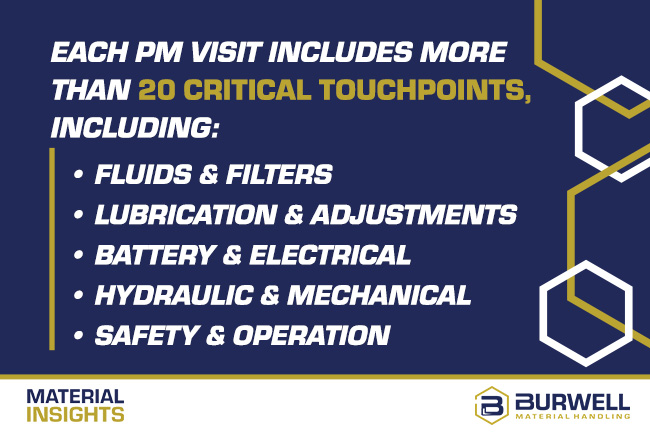
At Burwell Material Handling, Coffman says that each preventive maintenance (PM) visit includes more than 20 critical touchpoints, tailored to the specific brand and model of your equipment.
These comprehensive inspections ensure that every key component is evaluated to maintain performance, reliability, and TCO.
Overall, a typical PM should include checks for:
- Fluids & filters: Check/replace engine oil and filters; check/top transmission, hydraulic, steering, and differential fluids; inspect/replace air and fuel filters.
- Lubrication & adjustments: Grease fittings; inspect/adjust linkages, belts, chains, mast, steering, and brakes.
- Battery & electrical: Test batteries/cables/terminals (add water as needed); inspect contactors/ignition/switches.
- Hydraulic & mechanical: Inspect lift/tilt cylinders, hoses, and anchors for leaks/wear.
- Safety & operation: Verify lights/seatbelts/extinguisher/interlocks; inspect tires, forks, attachments; check operational performance.
Following the PM, you should also get a report that details the inspection and services provided for the visit, Coffman says.
“That report can essentially help serve as your TCO dashboard,” she says. “You’ll see what’s good, what’s borderline, and what to plan for next quarter.”
Set Up Your PM Plan in 30 Minutes
Coffman says it takes less time than you think to set your fleet up for success with a PM plan.
- Pick your cadence: Decide which service intervals work best for you, whether hours-based (e.g., 250 hours) or quarterly.
- Bundle units: Determine which units will be tagged for PM service during a single visit, to minimize trip fees by service technicians.
- Book the window: Schedule your PMs during lower volume periods of production.
- Stay proactive: Use the inspection report to prioritize the next visit.
“Better control over your total cost of ownership starts with one PM visit,” Coffman says. “That first visit is the turning point in your operations leading to fewer surprises, more uptime, and a smarter way to stay ahead of the next breakdown.
*Averages based on Burwell Material Handling internal field analysis; actual costs vary by model, environment, and utilization.
FAQ: PMs and TCO
How do PMs manage your forklift TCO?
They prevent costly failures, cut downtime, extend asset life, and make budgets predictable by catching low-cost fixes before they escalate.
How often should I schedule forklift PMs?
Match to usage. Many Class 5 IC models require them around ~250 hours or every 3 months (environment and duty cycle matter).
How long does a forklift PM take?
Typically ~1.5-2.5 hours per unit; schedule during slower windows to avoid production impact.
What’s the typical cost difference between PM and reactive repair?
Averages often run ~$300 per PM vs. ~$1,600 for reactive events, with certain failures jumping into the $3,000+ range (such as hydraulics and engines).
What exactly is covered during a PM?
Fluids/filters, lubrication, adjustments, battery/electrical checks, hydraulic/mechanical inspections, and complete safety/operational checks. Your PM should also include a comprehensive service report.
Ready to lower your TCO with a simple, predictable PM plan? Let’s line up your first visit.