
Robotics vs. Automation for Distribution Centers: What’s the Difference?
You’re looking at technology to assist your team and help solve your material handling operations pain points.
But the solutions and what they’re called can be confusing.
One vendor calls something robotics. Another calls it automation. Internally, those words get treated like a single bucket …and that can just layer on more misunderstanding and misperceptions.
So what’s the difference between robotics vs. automation for distribution centers?
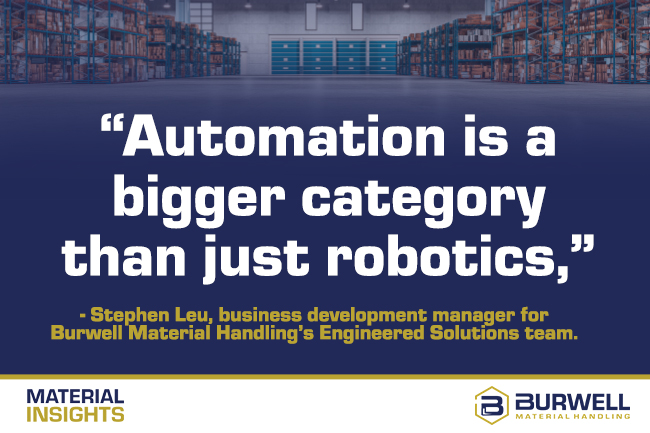
“Automation is a bigger category than just robotics,” says Stephen Leu, business development manager for Burwell Material Handling’s Engineered Solutions team.
If you’re trying to build an improvement roadmap or justify a budget, it’s helpful to define the terms first, so you can clearly talk about their potential impact and outcomes.
A simple way to think about robotics vs. automation
Here’s how Leu likes to separate the two types of technology when he’s talking about it with customers:
Automation is anything that removes manual steps, reduces touches, or standardizes a repeatable task.
“Conveyance, sortation, even some end-of-line packing stations,” Leu says.
For example, it could include a system that automatically applies shipping labels so a team member doesn’t have to peel and stick each one. That’s automation — clearly valuable — without being robotics.
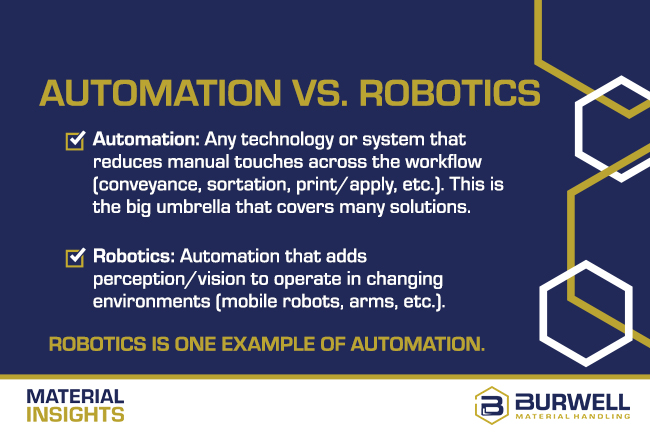
Think of automation as the big umbrella, Leu says, with many types of technology or systems that qualify. Robotics is one example of an automation solution.
A useful ‘line in the sand’ definition for robotics vs. automation
“We throw around these buzzwords: automation this, automation that or robotics,” Leu says. “But we often don’t take the time to clarify what we mean, so we make assumptions. That can lead to people not being on the same page, both internally and externally.”
Because the market’s language is messy, Leu uses a simple internal framework to draw a line in the send: Robotics is automation that adds perception.
“My personal definition of robotics is something that uses vision systems to navigate or decipher a scenario,” Leu says.
That’s why he’d label a vision-guided picking arm as robotics, even though it doesn’t drive around. It’s not about its mobility; it’s about how the technology is designed to perform.
“If it’s expensive, and it’s advanced automation, but there are no vision systems involved, I would consider that automation, but not robotics,” Leu says.
Why the distinction of robotics vs. automation changes real decisions
When teams lump everything into “robotics,” they tend to overestimate complexity, skip simpler wins, and chase the flashiest solution instead of addressing the real constraint.
“It’s helpful to define the categories and find the solution that best matches your need,” Leu says.
He says a better approach is to start with the constraint your operation is experiencing, such as throughput, labor, accuracy, safety, or space, and choose the right level of automation in a specific area to address a specific problem to start.
Robotics should only be used where perception from a vision system helps.
Quick takeaway for internal conversations on robotics vs. automation
- Automation = Any technology or system that reduces manual touches across the workflow (conveyance, sortation, print/apply, etc.). This is the big umbrella that covers many solutions.
- Robotics = Automation that adds perception/vision to operate in changing environments (mobile robots, arms, etc.). Robotics is one example of automation.
Next step
If you need help evaluating your pain points and mapping solutions that fit your needs, let’s talk. Burwell Material Handling’s team of experts can help you assess your operation.