

Safety Minute Best Practices for Material Handling Teams
In busy warehouses, shops, and distribution centers, job hazards for material handling operations change daily.
A simple yet effective way to build awareness is by implementing a safety minute — a short, intentional reminder before meetings or shifts.
“A safety minute should take 60 seconds or less to prepare and 60 seconds or less to deliver,” says Jesse Pruden, COO of Burwell Material Handling. “The point isn’t to overcomplicate it.”
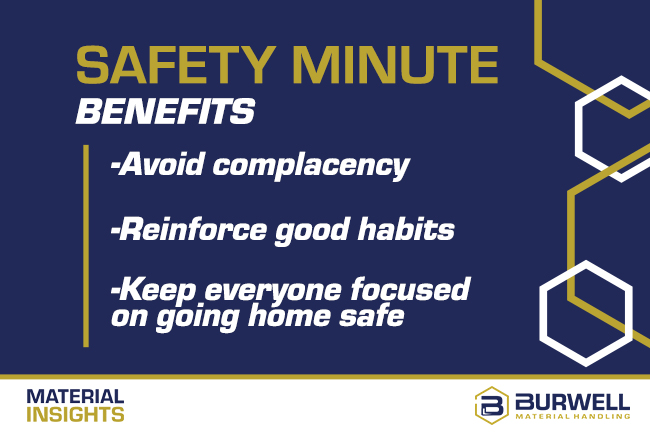
When done consistently, safety minutes help organizations avoid complacency, reinforce good habits, and keep everyone focused on going home safe.
In this article, Pruden provides his insights on safety minute best practices for material handling teams and how to make them work in your operation.
What Is a Good Safety Minute?
A safety minute focuses briefly on a safety topic, delivered at the start of a meeting or huddle. Best practice is to require one in any meeting with three or more people, whether virtual or in-person.
Topics can be:
- Work-related hazards (trip hazards, PPE requirements, forklift traffic)
- Task-specific reminders (working at height safety if that task is planned that day)
- Seasonal or personal safety tips (extreme temperature safety, storm preparedness, safe firework handling)
The goal is to keep safety top-of-mind, not to get into an extensive lecture or present a multi-slide deck.
How to Lead a Safety Minute
If you’re getting ready to introduce a safety minute to your operations, there are some important things you should know — but they should serve more as guidelines and not a rigid playbook, Pruden says.
“It’s about getting the thought of safety in the mindset of our team,” he says. “Over time, it becomes a habit.”
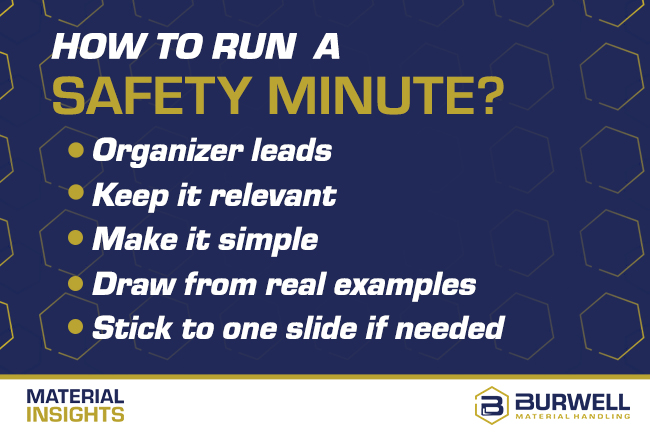
Each leader of the safety minute should be allowed to develop their own style in delivering them, to an appropriate extent.
“Just make sure it’s impactful,” Pruden says.
Frequency: How Often Should You Hold One?
Safety minutes should be held daily; at the start of each shift or morning huddle is ideal.
Pruden compares it to military briefings.
“Would you ever see a military operation go into a risky environment without a briefing?” he says. “They’re going to huddle up and say, here’s what we’re doing. This is the plan. These are the hazards. This is what we need to look for. So I take that to regular working day-to-day life.”
Material handling teams should remember that their environments and tasks at hand are constantly changing, Pruden says.
“It’s important to not get complacent,” he says.
Developing the Safety Minute Habit
Early on, organizations should emphasize consistency, not perfection.
Leaders should encourage their teams to adopt safety minutes by:
- Modeling it in their own meetings (even executive updates).
- Encouraging employees to gently remind each other if it gets skipped.
- Asking casually to team members or other leaders in the organization, “What was today’s safety minute?” to reinforce accountability.
The focus should be on building your safety culture, not punitively calling out misses. Over time, as it becomes standard within your organization, leaders can address persistent gaps one-on-one.
Best-Practice Checklist for Safety Minutes
- Include a safety minute in every meeting of three or more people.
- Limit prep and delivery to 60 seconds each.
- Use real-time relevance: today’s job, this week’s hazard, or a current event.
- Keep a running list of ideas to avoid repeats.
- Encourage team input and let different voices lead.
- Don’t make it punitive; focus on building a habit and culture.
Building Awareness for Material Handling Operations
Safety minutes don’t eliminate risk on their own, but they build awareness that prevents complacency. Over time, they:
- Reduce injuries by reinforcing daily vigilance.
- Build stronger safety culture across all levels of the organization.
- Show employees leadership cares about their well-being.
“Every day is different, and so are the hazards, even if the job looks the same,” Pruden says. “Safety minutes prepare the team to identify hazards they might otherwise miss.”
FAQ: Safety Minutes for Material Handling
What is a safety minute?
A short, intentional safety reminder delivered before meetings or huddles.
How long should a safety minute take?
60 seconds or less to prepare and 60 seconds or less to deliver.
Who should lead a safety minute?
The organizer of the meeting is responsible for delivering it.
How often should you do them?
Daily, ideally at the start of each shift or huddle.
How do you enforce them?
Focus on building habits and culture, not punishment. Casual check-ins and reminders work better than strict KPIs.