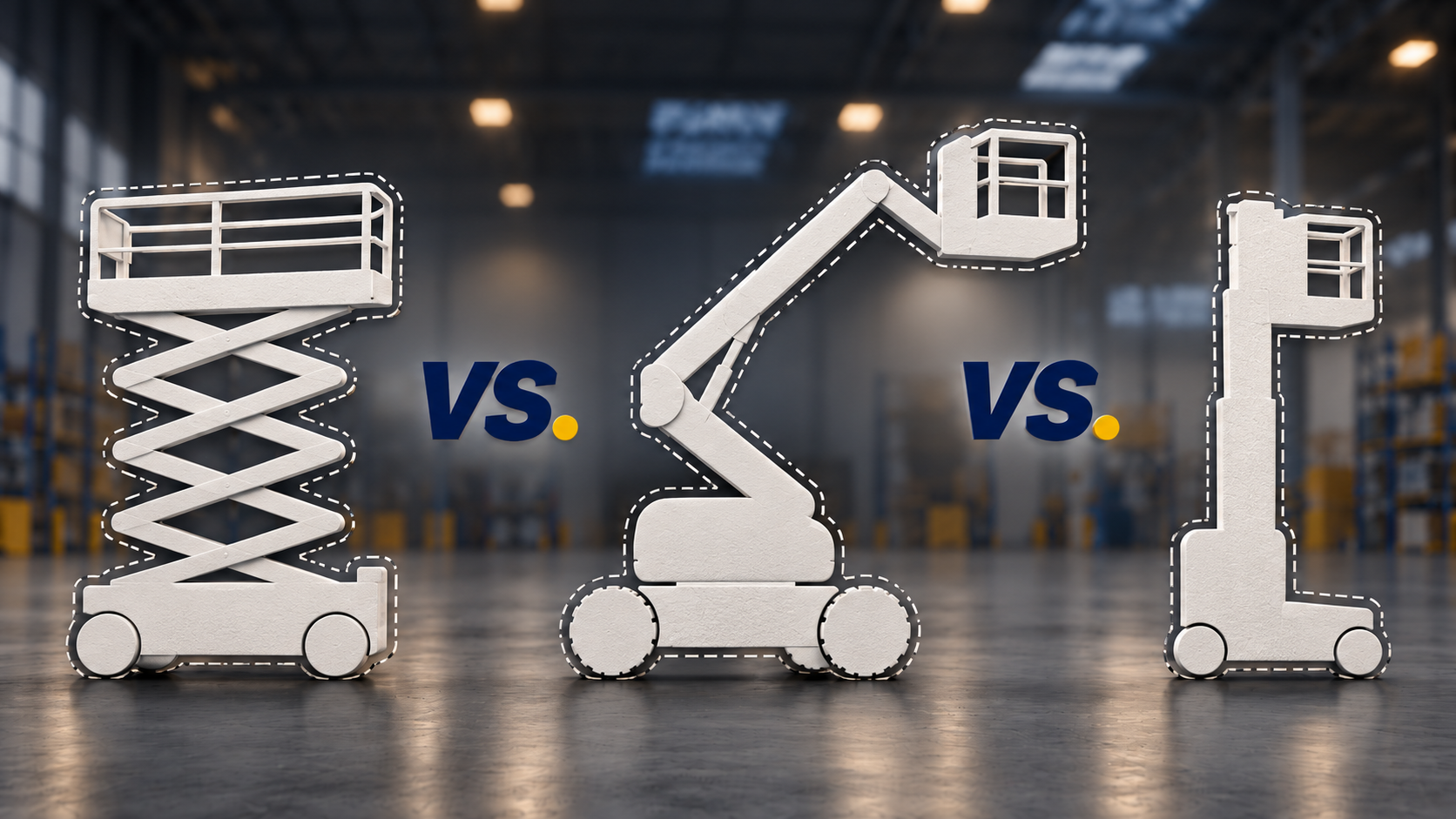
Scissor Lift vs. Boom Lift vs. Vertical Mast: Which Access Rental Fits the Work?
The work is 30 feet off the ground. That tells you how high you need to reach, but it doesn’t tell you which piece of Mobile Elevating Work Platform (MEWP) equipment to rent.
Is the work directly overhead or behind a pipe, rack or wall? Does the machine have to fit through a doorway or tight aisle to get there? Is one person going up with tools, or does the crew need room for materials?
Those details can turn the same 30-ft. job into a vertical mast, scissor lift, or boom lift application.
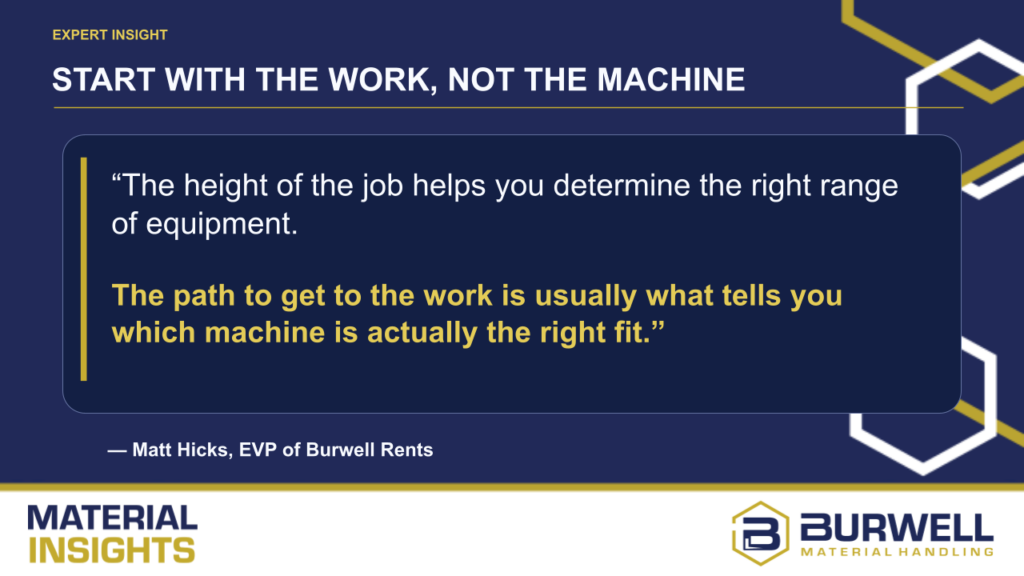
“The height of the job helps you determine the right range of equipment,” says Matt Hicks, EVP of Burwell Rents. “The path to get to the work is usually what tells you which machine is actually the right fit.”
Where is the work relative to where the MEWP can sit?
Hicks says the best way is to start by evaluating the work point and the space directly underneath it.
If the machine can park below the work and travel primarily straight up, a vertical mast or scissor lift may be the right equipment type.
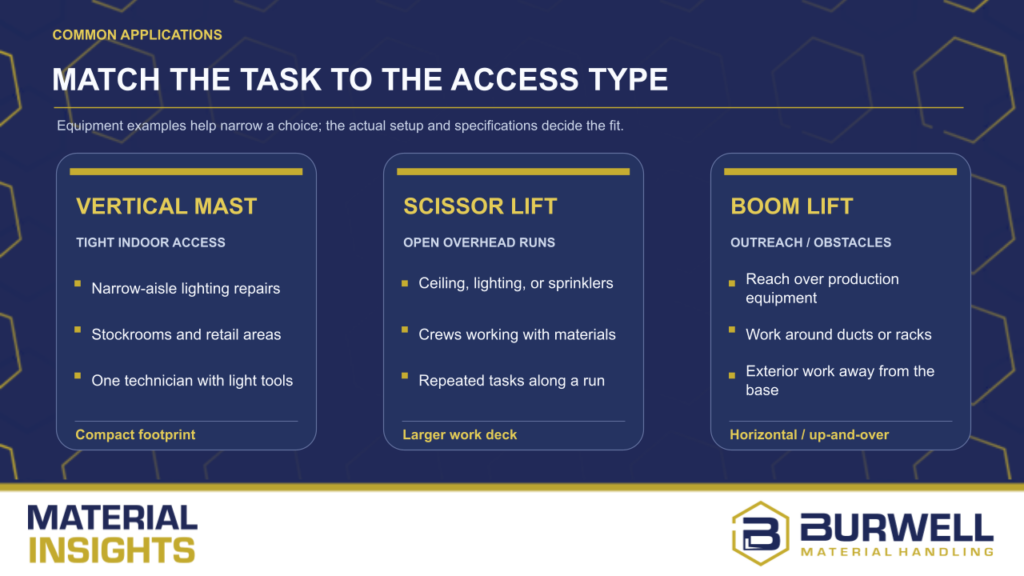
- A vertical mast lift works especially well when space is tight. Its compact footprint and maneuverability make it useful in narrow aisles, stockrooms, retail spaces and other indoor areas where a larger lift may be difficult to position.
- A scissor lift also travels vertically, but gives the crew more room to work. A larger deck can accommodate multiple workers, tools and materials, making scissor lifts a strong fit for ceiling work, lighting, sprinkler installation, and other tasks that progress along a relatively open run.
- A boom lift becomes a better choice when the work is above and away from where the machine can sit.
Think about a mechanic who needs to reach over production equipment, an electrician working behind ductwork, or an exterior crew that cannot park directly below the work. Boom lifts provide a larger working envelope that combines vertical height with horizontal outreach.
Within that category, the work path matters too. An articulating boom provides up-and-over positioning around obstacles, while a straight or telescopic boom is better suited to open approaches where longer outreach is the priority.
Can the MEWP actually get to the work area?
Choosing a MEWP based on reach alone can create a problem before the machine ever gets into position.
“Before you rent access equipment, we want to know what it has to pass through, what the ground environment will be, and what the crew needs to take up with them,” Hicks says. “Those details can change the recommendation pretty quickly.”
If you can, walk the route the rental will have to take from the delivery or staging point to the work.
Measure the narrowest doorway or gate. Look at aisle widths and turning room. Check overhead clearances, ramps, and elevators. Consider how much space the machine will have once it reaches the setup point.
A scissor lift may have exactly the working height you need but still be too wide for the opening it has to pass through. A boom may provide plenty of reach but need more room to maneuver than the site allows. A vertical mast may have less platform space but solve a difficult access problem inside a congested facility.
And make sure everyone is using the same height measurement. Platform height measures how high the platform floor can travel. Working height typically adds approximately 6 feet to account for an operator’s overhead reach.
Rather than simply asking for “a 30-foot lift,” tell the rental team where the work itself is located.
What needs to go up with the operator?
Next, look at the work happening on the platform.
One technician changing a light fixture has very different needs than two installers working with tools and material across an entire ceiling line.
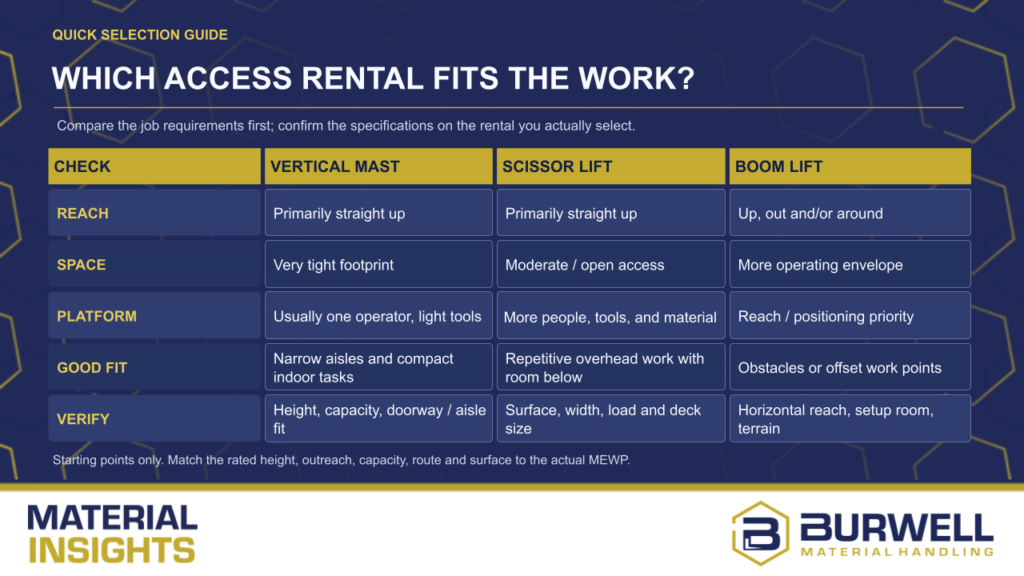
A useful starting comparison looks like this:
Keep in mind, these are starting points rather than universal rules. Platform dimensions, occupancy, and rated capacity vary by model, so the exact rental still needs to be checked against the people, tools, and materials that will be elevated.
That distinction matters. Scissor lifts are generally designed around a larger work platform and higher platform capacities, while compact vertical masts prioritize access and maneuverability. Boom lifts trade some of that deck space for the ability to position the platform farther away from the machine base.
“The best lift is the one that lets the crew actually do the job once they get up there,” Hicks says. “You have to consider all these factors: the people, the tools, and the material, along with the height.”
What surface will the MEWP travel and work on?
“Indoor” and “outdoor” are useful starting descriptions, but the actual surface tells the rental team much more.
A finished warehouse floor may favor an electric vertical mast, slab scissor, or electric boom depending on the required reach. An outdoor job on firm, level pavement may support several options. Gravel, uneven ground, grades or unimproved surfaces call for rough-terrain machines specifically configured to handle those conditions.
The rental team needs to know whether the MEWP will operate on polished concrete, asphalt, gravel, compacted soil, or another surface. Machine weight, tire configuration, gradeability, and floor-loading concerns can all affect the recommendation.
That same conversation should include the work environment. Exhaust, noise. and charging access may matter inside occupied facilities, while outdoor applications may introduce terrain, weather and grade considerations.
How will the work move throughout the shift?
Two machines may both reach the work and still create very different workdays.
Consider whether the rental is supporting one repair in one location or dozens of work points across a building.
If a crew is installing a long run of lighting or sprinklers with open space beneath it, a scissor lift’s larger platform and ability to move from point to point may fit the workflow well.
If the work is scattered behind obstacles, a boom’s outreach may let the operator access several locations without repeatedly positioning directly beneath each one.
In tighter interiors, a vertical mast’s smaller footprint can make it easier to move between individual work points.
“Think about how the work moves over the whole shift,” Hicks says. “If the crew has to keep coming down, moving things out of the way, and repositioning the machine, that adds up.”
Which access rental should you start with?
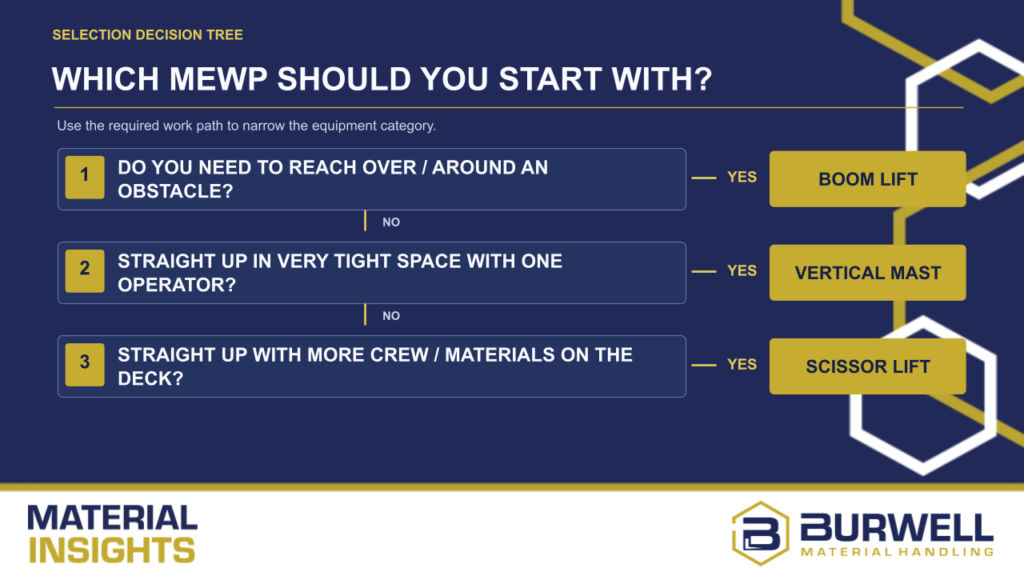
When you’re comparing the three categories, use the work itself to narrow the choice.
Then confirm the specific machine’s working height, horizontal reach if applicable, route into the work area, surface, platform capacity, and power requirements before reserving it.
Describe the job to the rental team, not name the machine
You don’t need to know the exact MEWP model before you call.
In fact, you may get a better recommendation by describing the work instead.
“You don’t need to know the model number when you call us,” Hicks says. “Tell us where the work is, what’s in the way, what the surface looks like, and what the crew needs to do. We can work backward from there.”
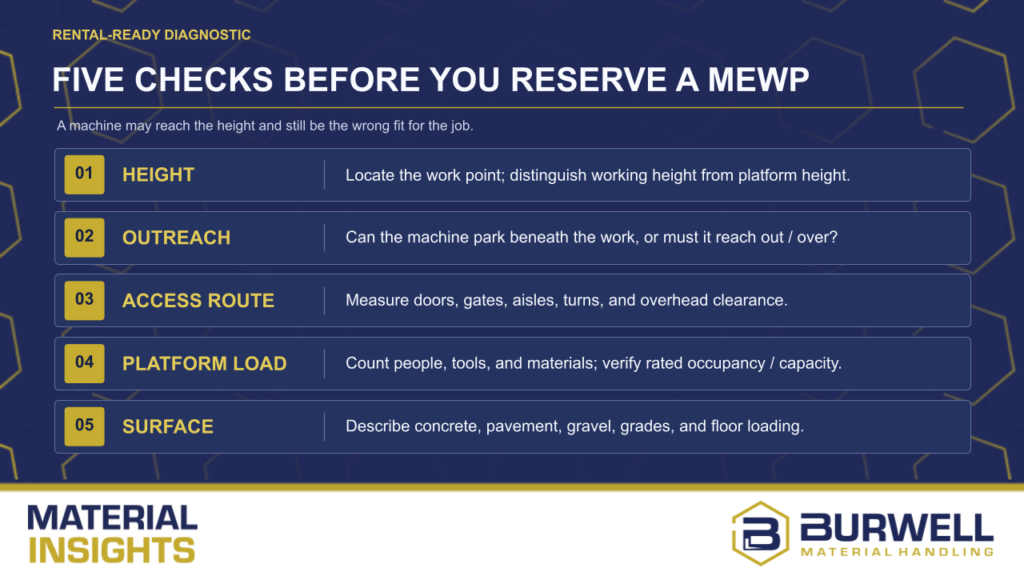
That conversation can help you avoid having an access equipment show up that technically reaches the height but creates a new problem: getting to or working at the actual job.
Next step
When you need to request an access equipment rental, work through these considerations, then contact Burwell Rents with the job and dates so the team can match the MEWP to the application.