
The Three Types of Overhead Cranes and How to Choose the Right One
Overhead cranes are a staple in industrial facilities and warehouses, helping to lift, move, and transport heavy loads with speed and precision.
Not only can they help clear floor congestion and speed up repetitive moves, but they also help to improve placement accuracy and efficiency.
“Each style of crane solves a different problem,” says Tom Racer, industrial products sales representative for the Engineered Solutions team at Burwell Material Handling. “Pick the right one, and you’ll gain capacity and safety without overbuilding.”
Today, we’ll take a look at the three types of overhead cranes, their benefits and which one might be the best fit for your facility.
What are the Three Types of Overhead Cranes
The three basic types of overhead cranes are:
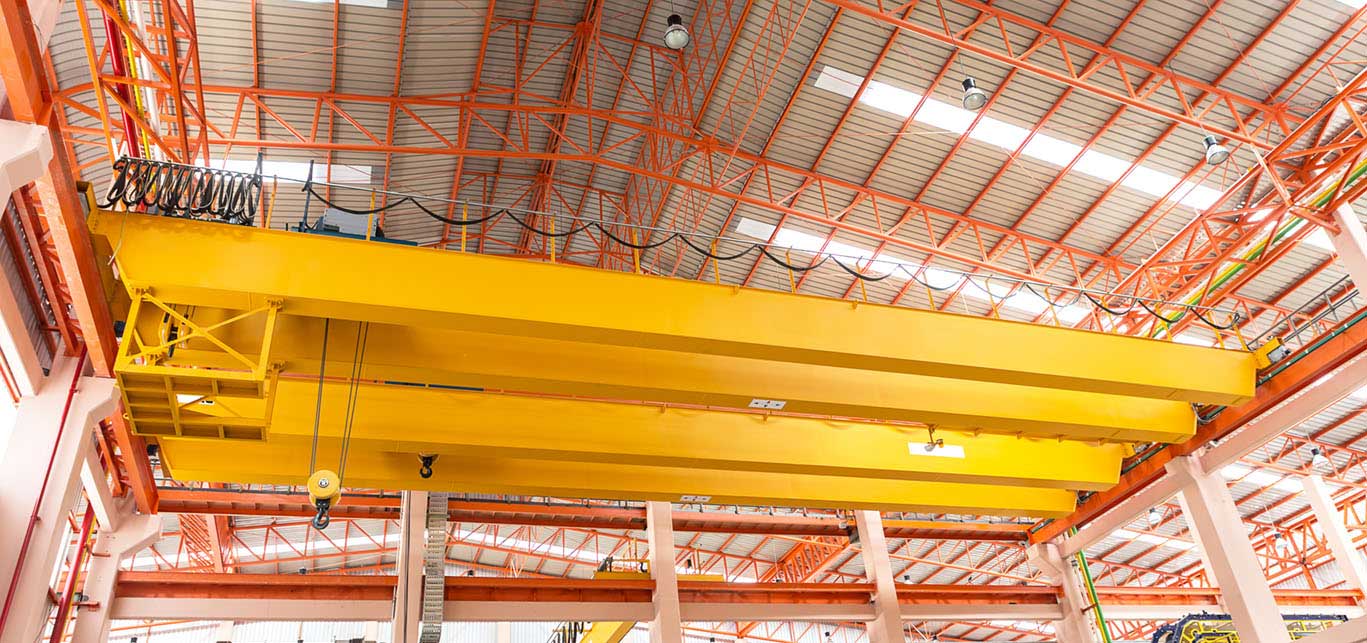
- Top‑running bridge crane: Top-running bridge cranes are the most common and widely used type of overhead crane. The bridge of this crane runs on top of parallel runways or rails that are supported by the building’s structure, allowing the crane to cover a wide area. Top-running bridge cranes are highly versatile, covering large areas, and can handle a wide range of capacities, from a few hundred pounds to hundreds of tons.
- Underhung bridge crane: Underhung cranes have the bridge suspended from the building’s support structure, rather than running on top of it. The trolley and hoist mechanism are supported from underneath the bridge. These cranes are good for lighter capacities, with typical capacities ranging from 1 to 10 tons, and when headroom is limited as they use less building clearance.
- Gantry crane: Gantry cranes feature a bridge that is supported by legs that extend down to the floor, rather than being suspended from overhead runways. This offers greater mobility, as they can be wheeled or rail-mounted to different locations within a facility. Gantry cranes are commonly used outdoors or in areas without overhead building support. They come in both portable/movable versions as well as more permanent, fixed-location models.
How to Pick the Right Crane Checklist
The specific type of overhead crane that’s best for your application will depend on factors like:
- The size and weight of the loads you need to handle
- The available overhead space and building clearance
- Whether the crane needs to be portable or fixed in location
- Your budget and facility layout constraints
“Take a look at your most frequent lift and the path it travels,” Racer says. “The crane that handles that move reliably is the right one for you.”
Consider factors such as:
- Capacity and duty cycle: Peak load, average load, picks/hour, required duty class.
- Span and hook approach: Width/height, obstructions, required headroom.
- Structure: Building steel/runway feasibility vs. freestanding/gantry legs.
- Controls and visibility: Pendant vs. radio; operator line‑of‑sight; spotter needs.
- Below‑the‑hook: Slings, spreaders, clamps, magnets — fit to load geometry.
FAQ: Crane Types
Which type handles the most capacity?
Top‑running bridge cranes typically support the highest capacities and longest spans.
What if I have low headroom?
Underhung systems help when you need the hoist and bridge below the runway to preserve headroom.
There’s no runway support in my building: Now what?
Choose a freestanding system or a gantry crane that carries its own legs to the floor.
Can these systems be automated?
Yes. Radio controls and semi‑automation are common; full automation depends on repeatability and safety constraints.
Next Steps
Not sure which crane fits your bay? Contact our team today.