
Forklift-Pedestrian Safety in Warehouses: A Guide to Preventing Accidents
Adapted with permission from Blaxtair
Forklifts and people often share the same space in busy warehouses. When visibility is limited or rules are unclear, near‑misses turn into injuries and costly downtime.
“Safety isn’t just PPE and signs — it’s the way your operations, material handling flow, and technology work together,” says Jeff Buyck, Chief Technology Officer for Burwell Material Handling. “Building a safety plan for your employees and equipment to work better and more safely around each other will help incidents decline.”
This guide turns broad safety advice for pedestrian traffic and forklifts into a concrete plan you can implement quickly.
What Causes Most Forklift-Pedestrian Incidents?
Despite efforts to control movements of forklifts and pedestrians, physical separation is not always feasible.
The layout of warehouses, distractions, and coactivity between machinery, truck drivers, and operators all contribute to the risk of collisions. Other causes include:
- Insufficient training: Operators or pedestrians don’t understand right‑of‑way, blind spots, or stop/clear protocols.
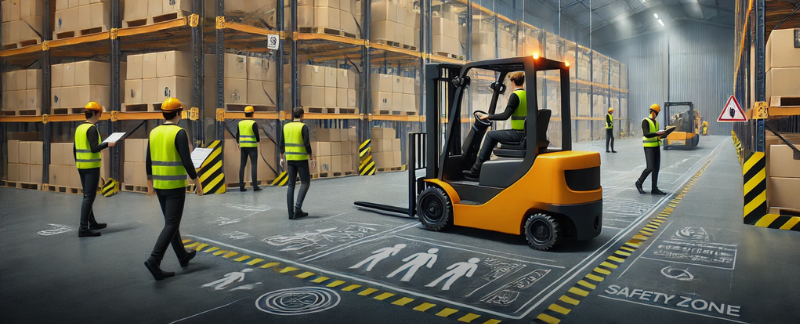
- Poor layout and visibility: Narrow aisles, blind corners, cluttered walkways, and unmarked crossings all create hazards.
- Equipment condition: Worn brakes/tires, weak horns/lights, or sensor faults that reduce stopping/awareness.
- Inconsistent rules: Undefined pedestrian lanes, unenforced speed limits, and no‑go/slow‑go zones.
What Reduces Risk Immediately?
Prioritizing these small steps can help reduce some of the risk to your employees:
- Designated pedestrian walkways with floor markings and physical barriers where feasible, and add mirror/lighting at blind corners.
- Post speed limits by zone. Make sure right‑of‑way rules at intersections and dock approaches are known. And add forklift‑only lanes where traffic is heavy.
- High‑visibility apparel and hand signals are crucial, along with radio calls or visual indicators for congested areas.
- Perform daily pre‑shift checks of brakes, horns, lights, and alarms, and repair defects immediately.
“By fostering a culture of safety, ensuring proper training, and using available technologies, you can create safer warehouse environments for your employees and help significantly reduce accident rates,” Buyck says.
How Can Technology Help (Without Overcomplicating)?
Advancements in technology have significantly improved warehouse pedestrian safety, including:
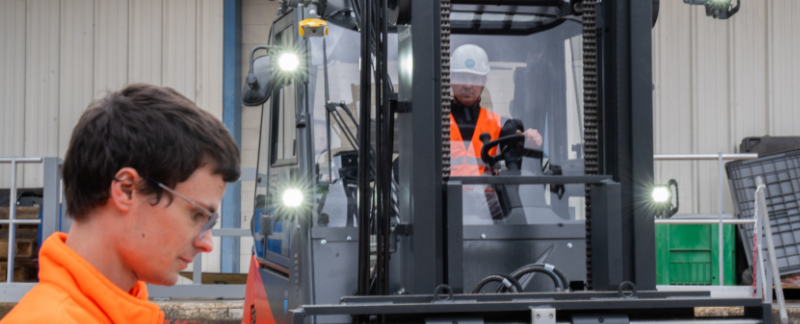
- AI pedestrian detection on forklifts: Alerts operators when people enter risk zones, which is effective in mixed traffic and blind spots.
- Forklift cameras (mast/rear/side): Expand visibility beyond mirrors, prevent accidents and collisions, and reduce strain from constant twisting.
- Proximity sensors and beacons: Create slow/stop behaviors in high‑risk zones and can be integrated with visual/audible alarms.
- Data and dashboards: Track near‑miss reports, alert frequency, and zone heatmaps to target fixes.
Five Step Rollout Plan
Fixing your safety culture doesn’t require a full overhaul right away. Consider taking small steps to proactively make changes, continually evaluating and improving as you’re able.
“Pick one hotspot of your warehouse to focus on initially with safety improvements,” Buyck says. “You’ll start to see a huge shift in productivity, efficiency and a dramatic drop in incidents. When your employees see the difference, adoption everywhere else will get easier.”
Follow these five steps:
- Map risk: Mark near‑miss hotspots, blind corners, and pedestrian‑dense tasks on a floor plan.
- Set rules: Speed limits by zone, right‑of‑way, crossing protocols; publish and train.
- Fix visibility: Add mirrors, lighting, floor lines, and barriers in priority areas.
- Layer tech: Pilot cameras + AI detection on the highest‑risk trucks/aisles; validate alerts.
- Measure & improve: Track incidents, near‑misses, alert counts, and compliance; tune procedures quarterly.
KPI Snapshot (Track Monthly)
| Metric | Target Trend | Notes |
| Near‑miss reports | ↑ then ↓ | Expect an initial rise as reporting improves; aim for decline over time |
| Incident rate (per 200k hours) | ↓ | Should fall with layout/rules/tech improvements |
| Training completion | ≈100% | Operators + pedestrians; refreshers after changes |
| Defect close‑out time | ↓ | Faster repairs on brakes/lights/alarms reduce risk |
FAQ: Forklift and Pedestrian Safety
What is the most effective way to separate people and forklifts?
Combine marked walkways and barriers with enforced speed/ROW rules. Add mirrors/lighting at blind corners, and post speed limits.
Do cameras or AI replace training?
No. Technology augments training by improving visibility and alerting operators to hidden risks.
How soon can we see results once we implement a better safety plan?
Sites often see fewer near‑misses within weeks after fixing just one hotspot and piloting cameras or AI on forklifts.
What if full separation isn’t possible?
Use layered controls, such as walkways + speed/ROW rules + visibility upgrades + detection alerts in mixed‑traffic zones.
Next Step
Do you want help mapping your warehouse’s hotspots and piloting a layered safety plan? We are here to guide you.