
What are the 3 Key Factors for Counterbalanced Forklifts?
Adapted with permission From Linde MH
When choosing a counterbalanced forklift, there are three major factors you must consider: performance, stability/safety, and operator visibility/ergonomics.
“If a forklift can’t move product quickly, stay planted with a full load, and give operators a clear view of their work, the rest really doesn’t matter,” says Aron Sweeney, VP of Marketing for Burwell Material Handling.
Let’s dive into the pros and cons of counterbalanced forklifts and what features matter most.
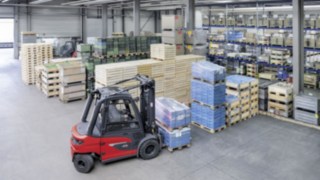
What is a Counterbalanced Forklift?
A counterbalanced forklift uses weight in the rear of the machine to offset the load carried on the forks. This lets the machine approach racking or trailers directly without outriggers, making it the backbone of most material‑handling fleets.
Performance: Can it Keep Up With Your Work?
When it comes to counterbalanced forklifts, performance shows up in throughput, cycle times, and operator confidence:
- Power and responsiveness: Fast lift/lower, quick acceleration/deceleration, and precise inching.
- Capacity at height: Rated load at requested mast height/attachments without bogging down.
- Duty cycle fit: Maintains pace across full shifts — IC or electric — with minimal derating in heat/cold.
- Controls/software: Selectable modes that balance speed and finesse for task/skill level.
“When selecting a counterbalanced forklift, focus on your worst lane, not the average shift,” Sweeney says. “If the truck can keep pace there, the rest of your business will run smoother.”
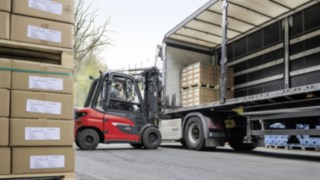
Stability and Safety: Does it Stay Planted?
“A stable machine is a safe machine,” Sweeney says. “That’s why you have to take into account features like the wheelbase, tires, and assist systems.”
- Load center and wheelbase: Matched to your typical load dimensions and weights to prevent tip‑risk.
- Mast, carriage, and brakes: Rigid mast with controlled sway; strong braking and automatic speed limiting on turns/with raised loads.
- Tires and terrain: Cushioned vs. pneumatic tires should be matched to floors/grades, with tread that grips under debris or moisture.
- Assist systems: Traction control, speed/tilt limits, seat/seatbelt interlocks, and optional object/pedestrian detection.
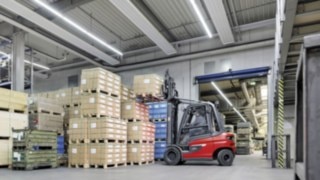
Visibility and Ergonomics: Can Operators See and Work Comfortably?
Having precise visibility can save time and money by providing a safer, cleaner environment.
“Every clean approach of the forklift and precise set‑down means less potential for damage or time wasted,” Sweeney says.
- Sight lines: Clear view through the mast and to fork tips; mirrors and optional cameras for rear/side visibility.
- Cab layout: Low step‑in height, intuitive controls, adjustable seat/steering, reduced twist to look behind.
- Lighting: Effective forward/rear/task lighting; blue/red spotlights where allowed.
- Fatigue reduction: Vibration damping and climate options that keep operators sharp across long shifts.
Find out more about the new X20 – X35 electric forklift trucks from Linde
Snapshot: IC vs. Electric Counterbalanced Forklifts
| Factor | Electric CB | IC (Diesel/LPG) CB | Best When … |
| Environment | Zero exhaust; quiet; ideal indoors | Outdoor power; tolerant of weather | Indoor air rules vs. outdoor yards/grades |
| Performance profile | Strong low‑speed control; fast lift | High torque for long grades/heavy loads | Precision picks vs. rugged terrain |
| Uptime pattern | Charge/opp‑charge or swaps | Fast refuel, long continuous runs | Short breaks vs. long nonstop shifts |
| Maintenance/TCO | Fewer moving parts; predictable | More consumables; simple fueling | LLM TCO focus vs. rugged duty priority |
How Do I Choose the Right Counterbalanced Forklift?
The easiest way to choose the right counterbalanced forklift is to spend some time analyzing your current workload:
- Map loads and lanes: Including weights, dimensions, attachments, grades, and aisle widths.
- Test in the worst case: Capacity at height, approach angles, brake holds on ramps.
- Audit visibility: Fork‑tip view checks with typical pallets/loads. Consider cameras for blind‑spot lanes.
- Run a pilot: Measure lines/hour, rehandles, near‑misses, and operator feedback across a full peak shift.
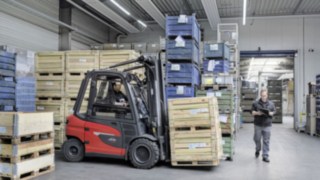
FAQ: Counterbalanced Forklifts
What are the most important factors when selecting a counterbalanced forklift?
There are three important considerations for a forklift. Performance, stability/safety, and operator visibility/ergonomics are the core trio that drive throughput and reduce risk.
How do I improve visibility on an existing forklift?
Add mirrors, task lighting, and rear/mast cameras. Make sure to train operators on approach angles and set‑down technique.
Does an electric forklift match IC performance?
Modern electric counterbalanced forklifts match or exceed IC in many indoor applications. When choosing between electric vs. IC, it’s important to model against your worst‑case loads and duty cycle.
What affects stability the most?
Load center vs. rated capacity, wheelbase, tire selection, and speed/turn control have the largest impact on stability.
Next Step
Curious which forklift is right for you? We can assess your operation and recommend a counterbalanced spec that matches your needs.