
Brownfield Warehouse Automation Reality Check: How to Upgrade Without Shutting Down Shipping
Most warehouse automation projects do not happen in an empty building with a clean floor, open schedule, and no orders to ship.
They happen in existing facilities, where orders still need to be filled and the business cannot simply pause while a new system is installed.
That is the challenge of brownfield warehouse automation: Improving an operation that still has to operate.
Upgrading an active facility goes beyond choosing the right technology to requiring a transition plan that protects shipping, receiving, labor, safety, and customer commitments while the project is underway.
Here’s what to think through before bringing automation into an existing warehouse.
Make sure the operation is actually ready for automation
Automation can solve major problems. It can also expose problems a facility is not ready to solve, says Stephen Leu, Business Development Manager for Burwell Material Handling’s Engineered Solutions team.
That is why readiness matters. Leu describes one facility visit where the customer desired automation, but the operation was not ready.
“They talked about, we want to automate this facility,” Leu says. “And I got there and I said, you don’t want to automate this facility.”
The building had more basic constraints to address first.
“I told them, ‘You’ve got no space,’” Leu says. “You’re currently putting pallets on the ground, stacking them up because you don’t have any pallet racking space. And you’ve only got one forklift in the building.”
That kind of situation may call for storage improvements, layout changes, process discipline, or equipment planning before automation enters the conversation.
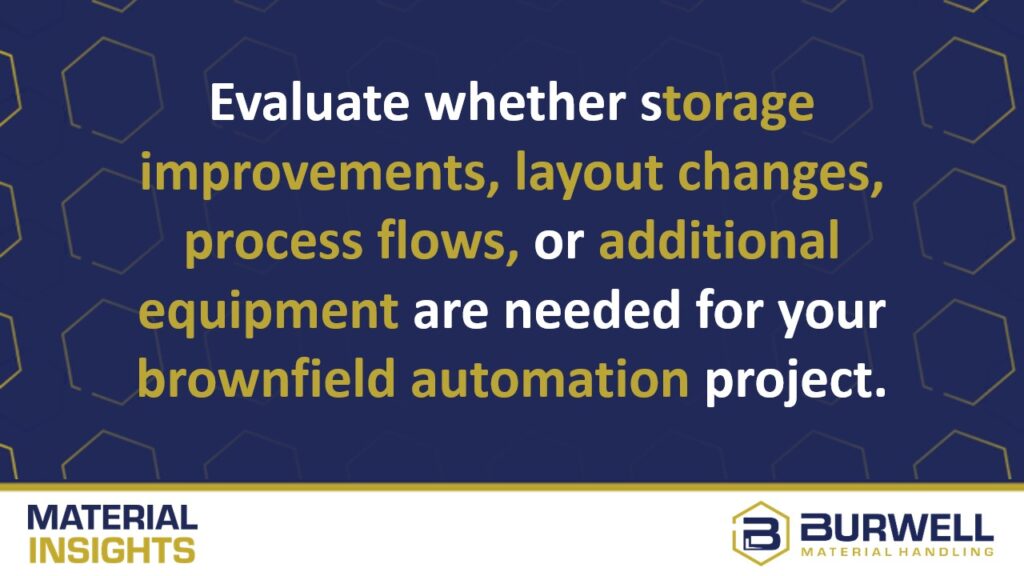
A brownfield project should start with a warehouse assessment and readiness check:
- Do you have enough space to support the proposed system?
- Is your inventory stored and managed accurately?
- Is your current process stable enough to improve?
- Do you have data to support the investment?
- Are the upstream and downstream areas ready for increased flow?
- Does the facility infrastructure support the technology?
If the answer is “not yet,” that simply means the first phase may need to prepare the operation for automation rather than moving immediately to it.
Look upstream and downstream before automating one area
One of the most common brownfield mistakes is improving one part of the operation without accounting for what happens next.
Picking is an easy example.
“An easy one is to say let’s automate your picking, but then you’ve not accounted for potentially the reduced amount of time that a picker will be picking, and then your packing gets an influx of orders,” Leu says.
If packing cannot absorb that increased flow, the operation may not see the improvement it expected. Picking gets faster, but orders still do not leave the building faster. The bottleneck simply moves.
“You just alleviate one bottleneck and don’t address another one,” Leu says.
That is why a brownfield automation plan has to evaluate the full flow:
- Receiving
- Putaway
- Replenishment
- Picking
- Packing
- Sortation
- Staging
- Shipping
“Any good integrator creates a material flow diagram, which includes totes per hour or units per hour from multiple different sections and makes sure that the flow can process through all of those areas,” Leu says.
Model the flow before implementation starts
A strong brownfield warehouse automation plan should stress-test assumptions before equipment is installed.
That may include modeling the operation virtually, simulating flow, or using input/output assumptions to see where constraints may appear.
“A good integrator will build out virtually the person’s operation with the inputs and see what those inputs start flagging,” Leu says.
Sometimes the operation may need temporary labor or a different process during implementation to keep flow balanced.
“It sometimes depends on the budget,” Leu says. “Or perhaps the operation wants to address packing before picking because it could be easier for them to do that, and then we take on the behemoth.”
Before implementation begins, ask:
- What area will automation improve first?
- What area will feel the increased volume next?
- Can downstream processes keep up?
- Is temporary labor needed during transition?
- Is there enough staging space?
- What assumptions are driving the model?
- What happens during peak volume?
A brownfield project should not only answer whether the solution will work, but also whether the operation can absorb the change.
Prepare the facility, not just the workflow
With brownfield warehouse automation, the facility itself has to support the solution.
“Facility preparation is a key predetermining factor,” Leu says.
Depending on the technology, that may include:
- Electrical assessment
- Charging infrastructure
- Floor assessment and remediation
- Fire suppression
- Permitting
- Seismic considerations
- Installation access
- Transportation and logistics planning
- Vendor staging space
Electrical capacity is one of the most obvious examples. If a solution involves a large number of robots, chargers, conveyors, or controls, the building has to support that load.
“We can recommend a technology that would help them, but if their infrastructure is not there, it’s not a solution that will work for them without addressing that first,” Leu says.
Floor conditions can also matter, especially for systems that move vertically or require tight tolerances.
“We’ll do floor assessment,” Leu says. “That’s really important, especially if you’re going up tall.”
Fire suppression and permitting can also become major project considerations.
“Permitting and fire suppression are one of the largest hidden costs associated with brownfield warehouse automation,” Leu says.
The building readiness conversation should happen early, Leu says, not after the solution is already in motion.
Build the transition plan around communication and variables
Even with the best planning, brownfield warehouse automation projects involve variables. One delay can change the entire project sequence.
That is why timeline mapping and communication are essential.
Leu says the Engineered Solutions team at Burwell Material Handling builds a Gantt chart to help identify the sequence of work and the items that determine the project timeline. If one vendor’s lead time changes, that may become the new constraint.
When that happens, the operation needs options, Leu says. Maybe another vendor can meet the timeline at a higher cost. Maybe the project can absorb the delay. Maybe the timeline has to be adjusted because of a lease, move-out date, peak season, or customer commitment.
The point is to keep the customer in the decision-making process, Leu says.
“Those are things that we’ll be actively in conversation with them,” he says.
As the customer, you need to understand:
- What has changed
- What choices are available
- What each choice does to cost or timeline
- What impact it may have on operations
- What deadlines cannot move
A brownfield warehouse automation project should plan for variables and define how the team will respond when something changes.
A practical brownfield warehouse automation readiness checklist
Before installation starts, make sure the team has answers to these questions:
- What work function is being improved?
- What upstream and downstream areas may be affected?
- Can those areas absorb the change?
- What facility work is required before installation?
- What electrical, floor, fire suppression, or permitting needs exist?
- What temporary workflows will be used during transition?
- Who owns communication when timelines or variables shift?
- What business deadlines need to be protected?
- How will the system be tested before full adoption?
Brownfield warehouse automation plans should treat implementation as a carefully thought-out transition from one operating model to another.
Next step
If your operation is exploring warehouse automation inside an existing facility, contact the Burwell Material Handling team of experts to help assess your current flow, facility readiness, and transition plan before you invest.