

What Should You Do With Forklift PM Findings?
A technician completes a routine forklift PM and identifies several issues. Some need immediate attention. Others may require a scheduled repair, closer monitoring, or a change in how the equipment is being used.
Who reviews those findings? Who decides what happens next? And how do you make sure the recommendations are addressed?
Tony Jennings, technical training manager at Burwell Material Handling, says one common problem occurs when the person signing off on a PM visit isn’t necessarily the person responsible for making fleet maintenance decisions.

“We need to make sure we have the right person at the customer facility to interpret the information,” Jennings says. “It needs to be somebody who’s a decision-maker for that business.”
A clear process for reviewing, prioritizing, and following through on PM findings can help fleet managers make better maintenance decisions and prevent problems from being overlooked.
Which PM findings need attention first?
Every finding deserves consideration, but some carry greater urgency than others.
Jennings teaches technicians to start with safety.
“If it’s a safety item, it’s a high priority,” he says. “All safety items should be the highest priority we have.”
Under OSHA 29 CFR 1910.178, powered industrial trucks that are defective, need repair, or are otherwise unsafe must be removed from service until restored to safe operating condition. Repairs must be performed by authorized personnel.
Once safety concerns have been addressed, Jennings says technicians should also consider whether a developing failure could damage additional components.
For example, let’s say you have a water pump that shows signs it’s beginning to fail. Jennings says its failure could extend beyond the pump itself to potential engine or cooling-system damage if it continues unaddressed.

Another example is discovering water in a forklift’s hydraulic fluid, he says.
“If I pull a dipstick on a hydraulic tank, and I’ve got water in it, that’s high priority,” Jennings says. “It’s going to affect every component downstream in that hydraulic system.”
Contamination could threaten the pump, valve body, cylinders, and other components. Addressing the condition promptly may prevent a much larger repair. High-cost components, such as transmissions and hydraulic pumps, should also weigh into the financial consequences if corrective action is delayed.
Jennings says fleet managers should have enough information from the technician’s PM findings to understand the urgency and make an informed decision.
Should you repair, monitor, train, or reevaluate?
A PM report may identify several issues that require different types of follow-up.
Some findings call for immediate corrective action. Others may reveal developing wear, indicate a need for operator training or raise questions about whether the equipment is suited to its application.
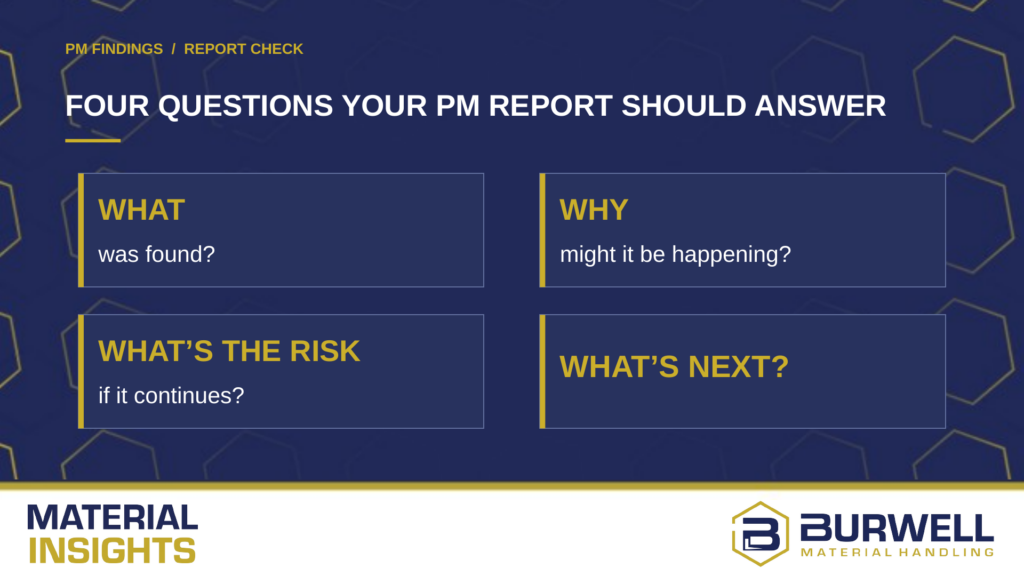
A practical starting point is to evaluate what the technician found and why it may be happening.
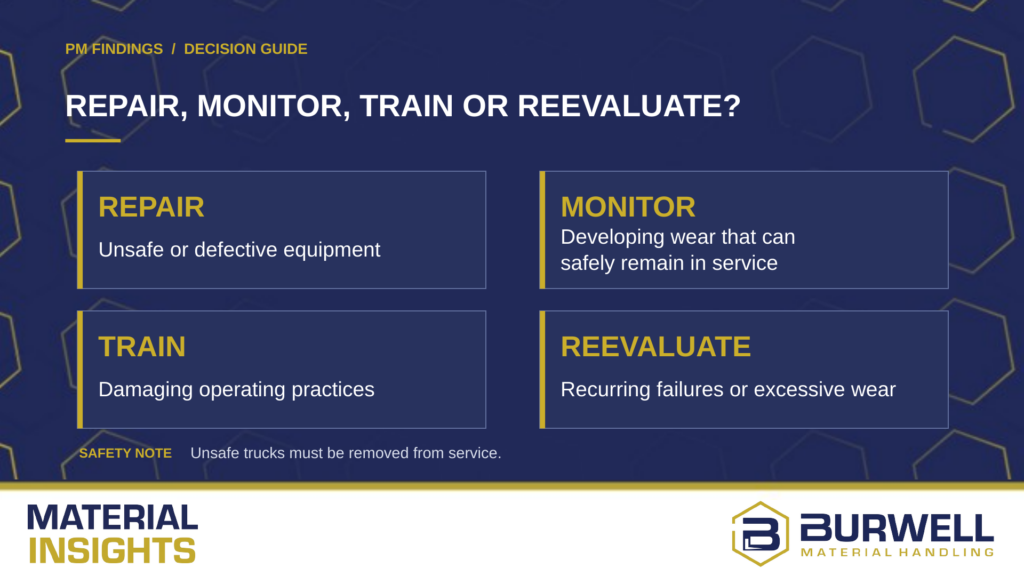
Jennings says one of the most important parts of a technician’s job is investigating the cause of a finding.
For example, if carriage rollers are repeatedly damaged, he wants technicians to consider whether the truck is experiencing side loading or impacts.
“We’re going to have to replace those rollers,” Jennings says. “But let’s talk about why they got to that point.”
That discussion can lead to a recommendation that addresses the underlying operating condition alongside the required repair.
What information should your service technician provide?
The way findings are communicated can influence how well the customer understands the recommendation.
Jennings gives the example of a technician identifying transmission fluid that is deteriorating faster than expected.
Simply recommending more frequent fluid changes can sound like another maintenance expense.
“If I come up to you and say, ‘You need to start changing your transmission fluid every 250 hours,’ all you see is dollars going out the door,” Jennings says.
But if the technician explains that the fluid is overheating, deteriorating prematurely, and potentially putting the transmission at risk, the customer has a better understanding of the consequences and available options.
“I teach technicians to give the customer the best professional information possible so they can make the right choice for their environment and financial situation,” Jennings says.
Who owns the follow-through on PM findings?
Once the service technician has communicated the findings, the customer needs an internal process to make sure appropriate action follows.
Jennings says identifying the correct decision-maker is essential. The person receiving and acknowledging the report needs to understand the information and have a way to get necessary decisions made.
That may be a fleet manager, maintenance manager, operations leader, or another designated person, depending on how the fleet and facility is managed.
A straightforward process can help:
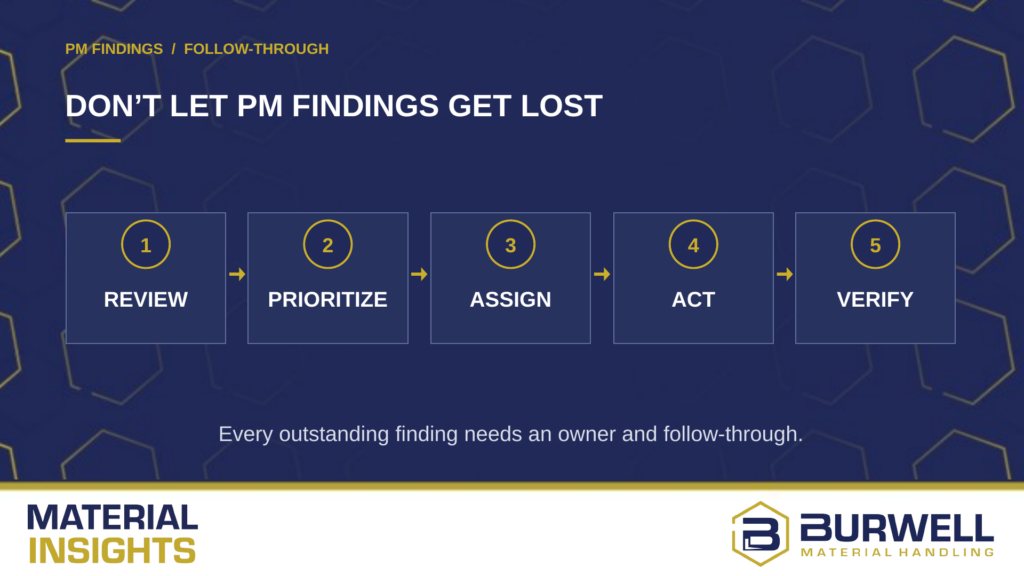
For findings that can safely be monitored, assign a follow-up date or operating-hour threshold, and identify the condition that would prompt action sooner.
For repairs, establish who authorizes the work, who schedules it, and how completion is documented.
Jennings emphasizes the importance of follow-up communication between the service provider and customer. He has been working to strengthen that process with service teams, including making sure recommendations and repair quotes reach the appropriate decision-makers and that those individuals have opportunities to ask questions.
He views that communication as part of a productive working relationship.
“My part of that role is to give you the information you need to make the best decision you can,” Jennings says. “We have to work together to make it work for both sides.”
The fleet manager’s responsibility is to make sure those decisions are carried through internally, including coordinating with operations when equipment must be taken out of service.
What can recurring PM findings tell you about your fleet?
An individual PM finding may point to a particular repair. Repeated findings can provide a broader picture of how equipment is being used and maintained.
If the same components repeatedly wear out prematurely, the service team and fleet manager should investigate why.
Jennings says planned maintenance should help support the equipment throughout its operating life.
“We’re trying to provide a planned maintenance schedule for the life cycle of your truck to reduce the cost of ownership,” he says.
For fleet managers, that means keeping PM findings accessible and reviewing whether recurring issues are actually being resolved.
A repair may address today’s problem. Understanding why the problem developed can help guide your maintenance and operating decisions for the future.
Next step
Take a look at the last completed PM report for one of your forklifts. Can you identify every outstanding finding, who is responsible for addressing it, and whether the recommended action has been completed or scheduled?
If you need help, contact your Burwell Material Handling service team to evaluate corrective options and recommend the appropriate next steps.