
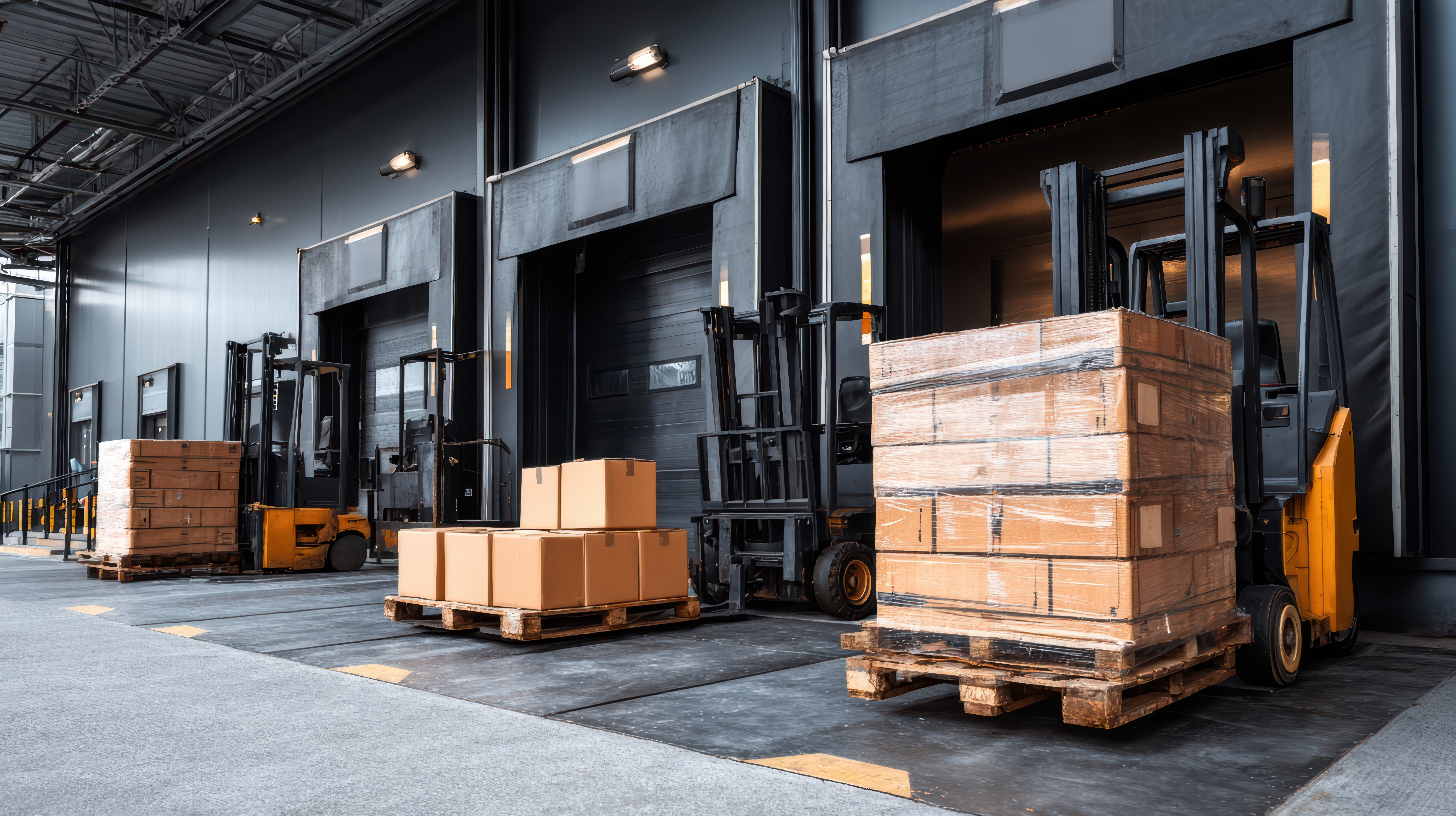
Dock-to-Stock: How to Fix the Hidden Receiving Bottleneck
When inbound product is sitting on the dock, the problem is not always unloading speed.
A truck may be unloaded quickly, yet the product may sit in staging, wait for inspection, cannot be entered into the system, or has nowhere to go.
That is why dock-to-stock time matters. It measures how long it takes for received product to become available for use, sale, picking, production, or replenishment.
But the dock is often where the bottleneck becomes visible, not necessarily where it starts.

“Receiving problems may show up at the dock, but that doesn’t mean the actual dock door is the problem,” says Tom Racer, industrial product sales representative for Burwell Material Handling. “You have to follow the product until it is actually available to the operation and see where the true issue lies.”
If you speed up one step without checking what happens next, the constraint can simply move somewhere else.
Dock-to-stock is one of the clearest places to see that happen.
What dock-to-stock really means
Dock-to-stock is the time between product arriving at your facility and product being available for the next step in your operation.
That may mean available for picking, production, replenishment, or sale. Or simply available in the system where your team can see it and use it.
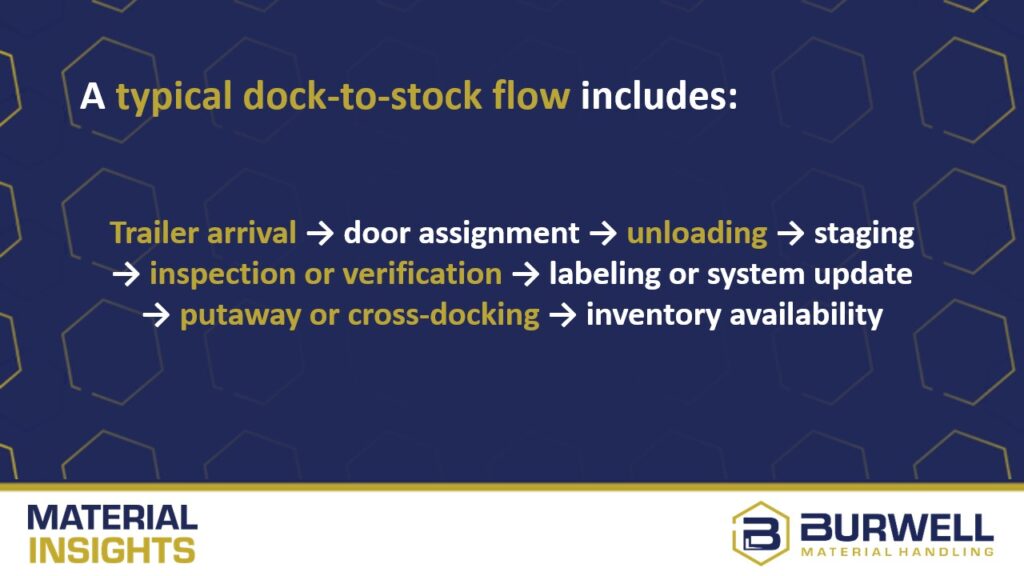
A typical dock-to-stock flow includes:
Trailer arrival → door assignment → unloading → staging → inspection or verification → labeling or system update → putaway or cross-docking → inventory availability
If any one of those steps slows down, product can sit in limbo. It may physically be inside the building, but operationally, it is not usable yet.
“If the pallet is off the trailer but no one can pick it, replenish from it, or use it in production, it’s not really through the process yet,” Racer says.
That is why dock-to-stock should not be treated as only a receiving metric, but it’s also a warehouse flow diagnostic.
Why receiving bottlenecks are often hidden
Receiving gets blamed when the dock looks crowded, but the real constraint may not be unloading.
It may be that inbound appointments are not leveled or loads may be arriving without the right notice or information. Staging may be too small or poorly marked or inspection may be under-resourced. Putaway labor or equipment may not be available.
“A dock can look busy all day and still not be the true constraint,” Racer says. “Sometimes receiving is waiting on putaway. Sometimes the system is waiting on accurate information.”

This is why a receiving bottleneck often feels like a dock problem even when it is actually a storage, labor, equipment, data, or layout problem.
A dock-to-stock evaluation takes that next step: What happens after the product crosses the threshold?
Follow the pallet, not the department
The best way to diagnose dock-to-stock delay is to follow the product.
Start when the trailer arrives. Track how long it takes to get a door. Then track unloading, staging, verification, labeling, system entry, putaway, and final availability.
“The best way to find the bottleneck is to follow one pallet from the trailer to its final location and time every handoff,” Racer says. “The delay is usually easier to see once you stop looking at receiving as one big step.”
That exercise helps separate processing time from wait time.
Processing time is work being done. Wait time is product sitting because the next action is not ready.
A pallet waiting 45 minutes for a door is a dock scheduling problem. A pallet waiting two hours in staging after unloading may be a putaway or storage problem. Each delay points to a different fix.
The common places dock-to-stock breaks down
Most dock-to-stock problems fall into a few predictable areas.
Arrival surges: If too many trucks arrive at once, the dock spends the day recovering. The issue may be appointment scheduling, carrier communication, labor planning, or how inbound volume is balanced across the day.
Staging overflow: If inbound product has no clear lane, zone, or temporary location, staging becomes storage. That blocks flow, adds extra touches, and creates safety issues.
“If staging becomes storage, the dock is already behind,” Racer says. “The goal is to keep freight moving through the dock, not let the dock become the warehouse’s overflow area.”
Verification or labeling delay: Product may be physically unloaded but still not usable because it has not been counted, inspected, labeled, or entered into the system. This is where the physical process and system process can fall out of sync.
Putaway constraint: If forklifts, pallet jacks, reach trucks, operators, or rack locations are not available, product sits after unloading. That creates the illusion of a receiving problem, but the constraint is downstream.
Poor storage fit: If product has nowhere logical to go, operators lose time deciding where to place it, moving it twice, or storing it in a location that slows picking later.
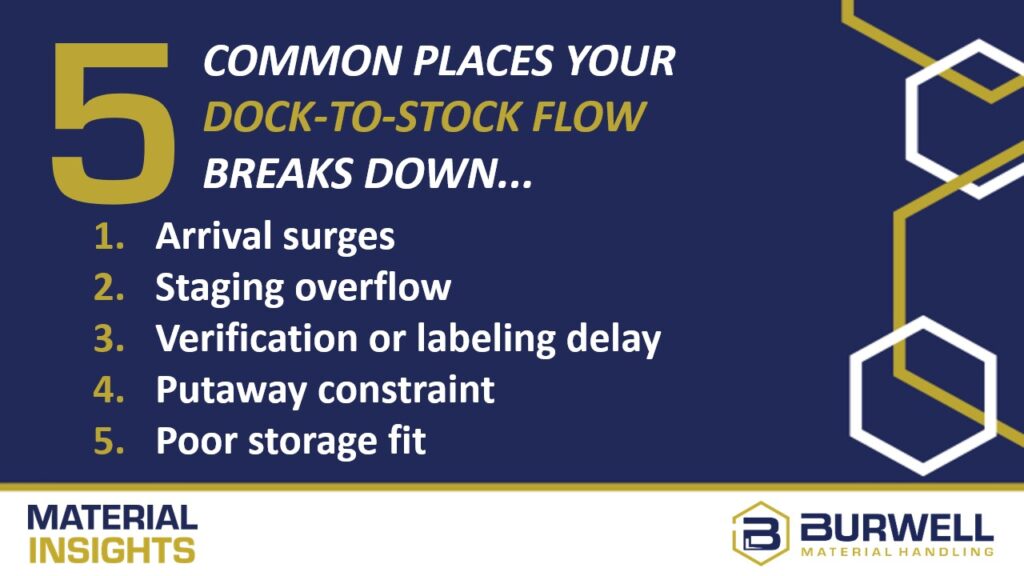
These issues can also stack together. For example, an arrival surge can overwhelm staging, which blocks traffic, which delays putaway, which causes inventory to sit unavailable longer than expected.
Fix the constraint in the right order
The answer is not always more dock doors. The fix depends on where the product stops.
“You don’t want to buy speed in one area and create congestion in the next one,” Racer says.
This is where physical material handling and process design have to work together.
More dock equipment may help if levelers, doors, seals, or dock safety systems are limiting throughput. Racking changes may help if product is stuck because there is no available or logical location. Conveyors or automation may help when repeated movement, staging, or handoffs are the real constraint.
But those investments should follow the diagnosis.
“Dock-to-stock is where a lot of warehouse issues show themselves,” Racer says. “If you solve it correctly, you’re not just cleaning up receiving. You’re improving the way the whole operation starts its day.”
A simple way to start
Start with one inbound load this week.
Track:
- Arrival to door assignment
- Door assignment to unloading
- Unloading to staging
- Staging to inspection or verification
- Verification to system update
- System update to putaway
- Putaway to inventory availability
Then ask where the product waited the longest.
Once you know where product stops, you can stop guessing and start fixing the right step.
Next step
If inbound freight is reaching your dock but not becoming available fast enough, contact your Burwell Material Handling team of experts. A warehouse and dock assessment can help identify whether the constraint is receiving flow, staging, putaway, storage, equipment, or a larger facility layout issue.