
Forklift Telematics Data: What Questions Should You Ask?
A forklift telematics dashboard can show a lot, but the real value comes when fleet managers know what to ask of the data and what action should follow.
“There’s the table-stakes stuff and then there’s what takes it to the next level,” says Jeff Buyck, CTO of Burwell Enterprises. “That’s where a lot of customers tend to fall off, because they maybe don’t know what questions to ask or what data to look for.”
This is where forklift telematics data moves from dashboard information to decision-making driver.
First, confirm the basic signals are being used
Before asking advanced fleet questions, make sure the foundation is working.
- Are operators logging in correctly?
- Are pre-op checklists being completed?
- Are failed checklist items being reviewed?
- Are impact alerts being seen by the right people?
- Are operator records current?
- Are reports going to someone who can act on them?
If those basics are not working, more data will not help much.
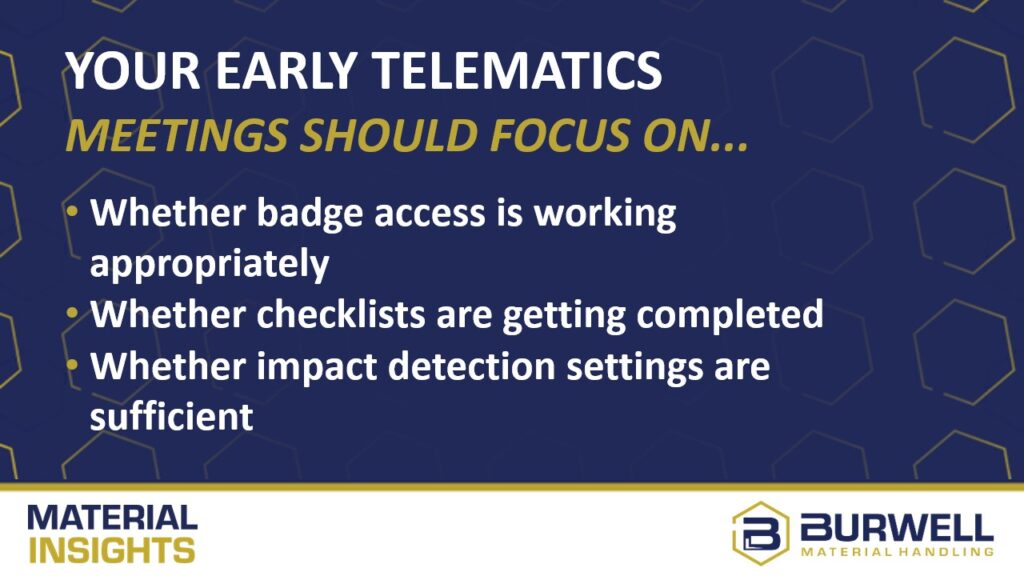
Buyck says early follow-up meetings often focus on confirming that everything that we set up is operating as it should. That includes badge access, checklist function, and impact detection settings.
This is the first layer of telematics value. It helps a facility understand whether the system is being used consistently and whether the data can be trusted.
Look at how the fleet spends its time
Once the basics are working, utilization is often one of the most useful places to start.
Buyck says utilization should not be viewed only as total hours. The better question is: What is the fleet actually doing during those hours?
“I think about utilization in buckets,” he says. “You’ve got your buckets of idle, working, and transport for each truck. You need to know how often each machine is falling into each bucket.”
That framework gives fleet managers a better way to ask questions.
- How much time are trucks working?
- How much time are they idling?
- How much time is spent transporting product or materials?
- Are some trucks doing most of the work while others sit?
- Are certain machines heavily used on one shift and barely touched on another?
“What time or how much time is your fleet actually working?” Buyck says. “Then you need to start asking the questions about what might be causing that.”
That last part matters. Utilization data is not the answer by itself; it is the beginning of the investigation.
If one truck has high hours, is it because the fleet is undersized or is it simply because that truck is closest to the work or operators prefer it? If another truck is consistently underused, is it truly unnecessary, or is it in the wrong place? Does it have the wrong attachment? Is it assigned to work that no longer happens the same way?
These questions can help fleet managers move beyond “how many hours are on the truck?” and toward “what does this tell us about the operation?”
Compare patterns by machine, operator, shift, and department
Telematics can also help managers compare patterns across machines, operators, shifts, and departments.
That does not mean using data as a “gotcha” tool, but more as a way to understand where people, equipment, process, or application may not be aligned.
Buyck says telematics creates “operator-by-operator data points” and “machine-by-machine data points.”
That opens up better questions:
- Is the same machine more efficient with certain operators on it?
- Are certain operators struggling with a specific equipment type?
- Are impacts concentrated in one department or travel path?
- Are failed checklist items tied to one shift?
- Are certain times of day more productive than others?
“Is the same machine more efficient with certain operators on it?” Buyck says. “Are we getting more work done during certain times of the day?”
Data patterns may point to operator training or traffic flow. It may reveal that one shift is working under different constraints. It may show that a department is short on equipment, borrowing from another area, or using the wrong type of truck because it is what happens to be available.
This is where telematics can connect to service, safety, training, and operations at the same time.
If a truck keeps triggering impacts or repair needs, the issue may not be isolated and may point to operator behavior, application fit, PM gaps, or a fleet need that has changed over time.
Use the data to make one decision at a time
The most useful telematics reviews produce action.
A fleet manager may review checklist completion or idle time, but the point is to leave with a decision: coach an operator, adjust a threshold, move a truck to another department, or schedule service.
Depending on the telematics platform, some systems can support even deeper questions by triggering diagnostic codes. Some dashboards may also include total cost of ownership data that supports conversations around leasing, owning, renting, or replacing equipment.
“Depending upon the telematics provider that we’re working with, you may have access to the codes that the truck’s throwing,” Buyck says. “So now we can be more proactive as a dealer.”
Quick question checklist
If you have forklift telematics data, start with these questions:
- Are operators logging in and completing checklists?
- Are failed checklist items being reviewed?
- Are impact alerts tied to a shift, department, route, or operator group?
- How much time is the fleet working, idling, or transporting?
- Which machines are overused or underused?
- Are certain operators more efficient with certain machines?
- Are certain shifts or departments using equipment differently?
- Are maintenance issues being caught earlier?
- Does the data point to rental, lease, purchase, redeployment, or retirement decisions?
- Who owns the next action?
Forklift telematics data should help the right people ask better questions, find the pattern faster, and decide what to do next, Buyck says.
Next step
If you are not sure how to turn your telematics data into action, contact your Burwell Material Handling team. We can help you identify the right questions, review the patterns, and connect fleet data to safety, service, utilization, and equipment decisions.