
Why Distribution Centers Use Robotics: The Top 4 Pressures They Solve
When considering robotics for your material handling operation, the first question you ask should never be “What robots should we buy?”
Instead, you need to ask: What pressure is forcing the operation to change?
Because the “right” robotics answer looks very different depending on whether you’re fighting space, labor, throughput, or risk.
Most robotics discussions begin after a facility hits a clear breaking point, says Stephen Leu, business development manager for Burwell Material Handling’s Engineered Solutions team.
Leu says the first move shouldn’t be to jump to technology, either for the operations team or for the vendor. The top priority should be to understand how the business currently works — and where its pain points exist.
“First, you need to gauge where their operation is today,” Leu says.
That usually means asking a series of methodical questions to unearth their process, spending time on-site, looking at how work actually flows, where congestion builds, and where people spend time that doesn’t add value.
This discovery should help reveal the true driver behind why robotics is even a consideration for your operation.
The four drivers behind robotics that show up most often
Leu says he usually sees a common pattern: when customers ask about robotics, it’s typically because growth or risk has pushed the operation to a point where manual processes can’t keep up.
He often sees the underlying cause land in one of two growth buckets — space or throughput. Alternatively, other triggers are sometimes quality or safety risk instead.
“More often than not, it’s usually storage or throughput driving an organization to seek out robotics solutions,” Leu says.
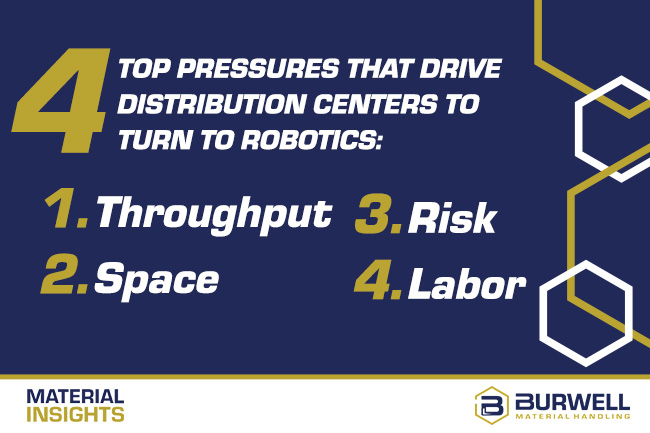
Here are the four pressures that come up again and again — and what they tend to mean in practical terms.
Pressure #1: Throughput growth you can’t staff your way out of
Some facilities are growing fast enough that adding headcount can’t close the gap, especially in picking and other labor-heavy steps. Leu says he saw one customer grow so quickly on the throughput side, the growth rate itself became the problem.
“They grew 20% year-over-year on the throughput side, and they could not keep up with manual labor at that rate,” Leu says.
The use of robotics in this type of scenario is about stabilizing output: reducing walking, reducing touches, and keeping products moving consistently during peaks.
Leu says it’s also why so many robotics projects start in the same place — picking — because that’s where throughput pain is easiest to quantify and hardest to “hire” your way out of.
Pressure #2: You’re out of space
The second growth constraint is storage capacity. When your operation is out of places to put product, you ultimately have two choices: Do you add square footage or do you change how you use the space you already have?
“Maybe you’re finding yourself out of room completely and then your only option is to expand a building or buy another building,” Leu says. “That gets expensive quickly and can take a lot of time.”
This is where robotics often enters as part of a bigger automation conversation.
Sometimes the solution is about going vertical, increasing density, or shifting how product is brought to people so aisles and pick paths don’t consume as much floor.
The key is that the “robot” isn’t the goal — unlocking capacity is, Leu says.
Pressure #3: Accuracy and liability (risk becomes the business case)
Not every project is driven by growth. Sometimes the most urgent driver is risk, with either order accuracy that’s damaging customer trust or safety/liability that leadership can’t ignore. Leu says that the trigger can shift from efficiency to exposure.
In extreme cases, the business case isn’t about picking faster at all — it’s about removing high-consequence failure modes.
Leu says he’s had a customer in the past where forklift interactions with racking had the potential to create catastrophic outcomes, and the organization decided robotics was their safest path forward.
“Risk mitigation was their entire reason to move to robotics and automate,” Leu says.
If you’re evaluating robotics for this reason, the right questions change. You care about separation of people and equipment, visibility, enforcement, and reducing the chance of a single incident taking the operation down.
Pressure #4: Labor turnover and the ‘always picking’ reality
Even when growth isn’t extreme, labor volatility can be. High turnover creates a constant training burden and a constant performance gap, especially in picking, where speed and accuracy depend heavily on experience.
Leu says this is the reality many warehouses face, where churn is constant.
“We’ve had a customer where 60% annual turnover was the norm,” he says.
In that environment, robotics and automation can reduce dependency on tribal knowledge, by standardizing moves, reducing walking, and simplifying training so performance doesn’t reset every time a shift changes.
Map your “why” before you map solutions
If you’re considering robotics, start by naming the pressure in one sentence.
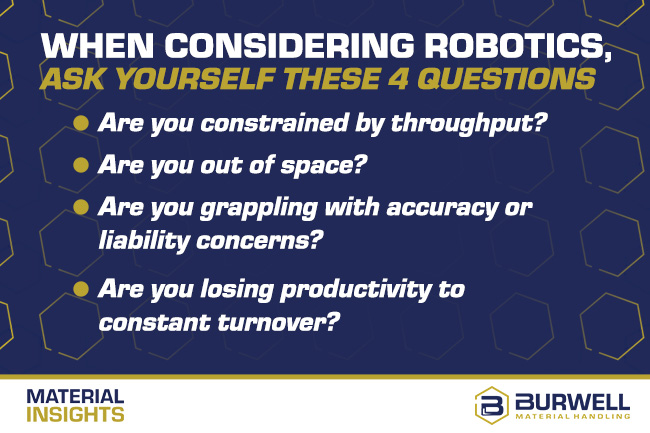
Are you constrained by throughput? Out of space? Fighting accuracy or liability? Or losing productivity to constant turnover?
That single answer will keep you focused and prevent you from shopping for technology before you’ve sized the problem.
From there, you can evaluate options the way Leu outlines: understand where you are today, clarify the constraint, and then decide what level of automation (robotics or otherwise) actually fits the job.
Next step
If you need help evaluating your pain points and mapping solutions that fit your needs, let’s talk. Burwell Material Handling’s team of experts can help you assess your operation.